Stenger outlines plans worth $600-million

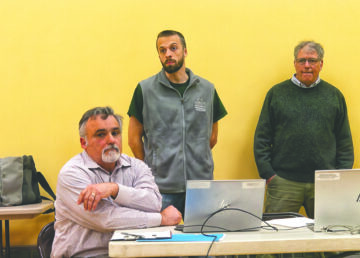
Bill Stenger. left, and U.S. Senator Patrick Leahy

copyright the Chronicle 10-3-2012

by Joseph Gresser

JAY — A $600-million investment plan set out by the owners of Jay Peak Resort Thursday could change the face of the Northeast Kingdom over the next three years.  In the process it could create ten thousand new jobs.

That was the message Bill Stenger, co-owner and president of the resort, delivered in a pair of press conferences, one held at Jay Peak, the other at the Gateway Center on Newport’s waterfront.

Sharing the stage with Mr. Stenger were U.S. Senators Patrick Leahy and Bernie Sanders, Congressman Peter Welch and Governor Peter Shumlin.

Most of Mr. Stenger’s plans focused on Newport.  They included construction of a new hotel and conference center on the site of the present Waterfront Plaza, the replacement of the Spates block with a five-story commercial and residential building, and construction of a 75,000-square-foot research building for AnC Bio, a bio medical research company.

any of the major players in Vermont politics mingle before the press conference announcing Jay Peak’s new investments. Developer Tony Pomerleau, seated at left, talks with Governor Peter Shumlin. Seated next to Mr. Pomerleau is his niece, Marcelle Leahy, who is speaking with her husband, Senator Patrick Leahy. Standing behind Senator Leahy is U.S. Senator Bernie Sanders. Jay Peak co-owner and president, Bill Stenger, waits at the podium at the far right to begin his presentation. Photos by Joseph Gresser

Mr. Stenger also announced that a German window manufacturer will move to Newport and set up shop in a portion of the old Bogner Building.

The Newport State Airport in Coventry will also get a makeover as Mr. Stenger and his business partner, Ariel Quiros, take over the operation of the field.  They will continue to work with Dan Lathrop of Lakeview Aviation, the current operator of the airport, and will add several hangers, a new terminal building and bonded warehouses.

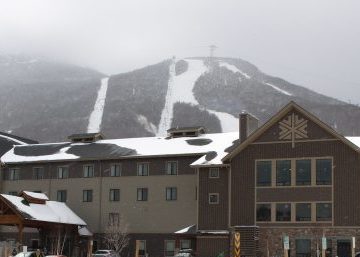
Mr. Stenger did not completely ignore his skiing properties.  At Jay Peak plans call for an expansion on the Stateside of the mountain where a hotel will be added.  An entirely new area is to be developed in the West Bowl, where a second new hotel is planned.

Mr. Quiros and Mr. Stenger bought the Burke Mountain ski area recently and announced a $102-million project that will include four new ski lodges there.

Ninety percent of the projects’ costs will be funded by money raised from the EB-5 visa program, which grants Green Cards to foreign citizens who invest $500,000 in an approved project that creates at least ten permanent jobs.  The new jobs can be created directly by the projects or indirectly as a result of increased economic activity spurred by the new businesses.

The expected total of over $500-million in EB-5 funds must result in more than 10,000 direct and indirect jobs before all Green Cards are issued by the federal government.

The EB-5 program, which has financed most of the $250-million in improvements made at Jay Peak over the past five years, was slated to expire this month.   Congress recently passed a bill reauthorizing the program for another three years, which President Barack Obama signed into law Friday, September 28.

Mr. Stenger gave much of the credit for the three-year extension of the visa program to Senator Leahy.  Unless the EB-5 program gets a further extension, the projects outlined by Mr. Stenger will have to be completed by 2015.

In his remarks Senator Leahy said he already has his staff working on a bill that would make the visa program a permanent part of U.S. law.

The backgrounds of those who seek to participate in the EB-5 program are investigated by federal immigration officials, as is the source of the funds to be invested.  Federal officials also must certify that the expected jobs have been created before a participant is given final resident status and a path to U.S. citizenship.

Mr. Stenger began his explanation of his investment plans by talking about the work that has been done at Jay Peak Resort over the past five years.  He said construction of two new hotels, a golf course and clubhouse, an indoor ice rink, and water park has resulted in a five-fold increase in Jay Peak’s payroll.

At present the ski area employs 1,200 people, Mr. Stenger said.

He said that Jay Peak has completed 75 percent of its expansion plans.  He said the resort plans to spend $170-million between 2013 and 2015 to build 100 homes, new lifts, an 84-unit hotel and a medical center on the Stateside portion of the ski area.

Mr. Stenger said Jay will build new lifts and trails as well as a new hotel in the West Bowl area of Jay Peak.

Moving east, Mr. Stenger outlined plans that would radically reshape the city of Newport.  Along with Mr. Quiros, Mr. Stenger plans to buy the block on the south side of Main Street between Second and Center streets from Doug and Vivian Spates.

The Spates block on Main Street in Newport occupies the space between Second and Center streets. Plans announced Thursday, September 27, at the Gateway Center call for the whole block to be torn down and replaced with a new five-story building combining retail, commercial and residential spaces.

Conceptual drawings by Black River Design show the new Renaissance Block across Main Street from the Goodrich Memorial Library. The top floors are designed to provide residents with a view of Lake Memphremagog. Drawings courtesy of Jay Peak Resort

Plans call for the Spates Block to be razed and replaced with a five-story building.  In accordance with Newport’s zoning code the ground floor would be devoted to retail space.  The second story will be devoted to office or other commercial uses, Mr. Stenger said, while the top three floors will be residential.

An architect’s rendering of the block showed a couple on the top floor of the building, enjoying a view of Lake Memphremagog from the terrace of their penthouse apartment.

The building, which will be called the Renaissance Block, is expected to cost $70-million and is slated for completion in 2014.

The following year the Newport Marina Hotel and Conference Center is scheduled to open on the site of the present Waterfront Plaza on the Causeway.  The cost of the 600-bed hotel is estimated to be $100-million.

The Newport Marina, Hotel and Conference Center, seen here in an architect’s rendering, is proposed for construction on the site of the present Waterfront Plaza.

Mr. Stenger said he is in discussions with Burlington developer Tony Pomerleau to purchase the property, which has extensive frontage on Lake Memphremagog.  Mr. Pomerleau was saluted for his contributions to the state at the press conference, which took place on the eve of his ninety-fifth birthday.

Mr. Stenger described the two projects as bookends for Newport’s Main Street, and asked his listeners to imagine a walk from the hotel up the city’s boardwalk and back down Main Street.

The other Newport developments will be concentrated at the former Bogner property, which was purchased by AnC Bio, the U.S. division of a South Korean biotechnology company.  Mr. Quiros and Mr. Stenger are owners of the U.S. division of AnC.

The biotech company will start manufacturing and distributing products from the existing 90,000-square-foot Bogner building in the spring of 2013.

Work on a 75,000-square-foot research center is to begin next fall at a total cost of $104-million.  The glass tower will essentially be a copy of the company’s research building in Seoul, South Korea.  Inside there will be clean rooms, equipment and research facilities available for lease by other companies or universities, according to William Kelly, the counselor for AnC Bio and Jay Peak.

Mr. Kelly said he expects that researchers will be drawn to the new facility because of the availability of the equipment.

The former Bogner building will have a second manufacturing tenant, this one a German manufacturer of energy-efficient windows.

Mr. Stenger said that one of the people who looked into investing in Jay’s EB-5 program turned out to be someone whose work involved scouting locations in the U.S. where foreign companies might want to locate.

He brought the Newport area to the attention of the owners of Menck Window Systems, who visited the area several times before committing to locating in Newport.

Mr. Stenger said representatives of the company, a 134-year-old family owned concern, were very impressed that Lawrence Miller, secretary of the state’s Agency of Commerce and Community Development, attended the meetings and was solicitous of their needs.

Bringing Menck to Newport will require a $20-million investment, he said, but will result in at least 140 full-time manufacturing jobs.

The Newport State Airport in Coventry will also see considerable investment.  The Federal Aviation Agency will extend the existing runway by 1,000 feet next year from 4,000 feet to 5,000 feet.

This, Mr. Stenger said, will make it possible for larger planes to land and take off, and change the economics of the field.

The existing  runway is to be resurfaced and a separate taxi-way will be built, Mr. Stenger said.

Plans call for the Jay Peak partners to take over operations of the airport, and build a new 10,000-square-foot terminal building, two 15,000-square-foot hangars, a 14,000-square-foot aircraft manufacturing and repair facility, and a 40,000-square-foot bonded warehouse in anticipation of the creation of a Free Trade Zone in Orleans County.

Work at the airport is expected to cost $20-million and be done between 2013 and 2014.

Mr. Stenger credited Senator Leahy with shepherding the visa program bill through the Senate, and thanked Congressman Welch for his work getting it passed by the House.  The legislation passed with overwhelming margins in both bodies.

Each member of the Congressional delegation spoke at the two press conferences, as did Governor Shumlin.  All praised Mr. Stenger and Mr. Quiros for their vision.

Senator Sanders said, “The most popular sport in America is complaining about the federal government.  What you are seeing here is a marriage and partnership between private business and federal, state and local government.”

Secretary Miller, speaking at the Gateway Center press conference, provided assurance that Mr. Stenger’s plans are likely to come to fruition.

He said that sophisticated investors from around the world have carefully examined Mr. Stenger’s plans and made half-million-dollar investments in his projects.

As to whether there are 5,000 people with the skills to take jobs in the new businesses, Mr. Miller pointed out that many people have left the state in search of work.

“We want them back.  We want them home,” Mr. Miller said.

To any who may doubt the reality of his plans, Mr. Stenger offered this assurance:  “We have the mission, we have the vision, we have a love for this community.  We will make it happen.”

contact Joseph Gresser at joseph@bartonchronicle.com

For more free articles from the Chronicle like this one, see our Editor’s Picks pages. For all the Chronicle’s stories, pick up a print copy or subscribe, either for print or digital editions.

Share

Huge land purchase worries neighbors

Bob and Sharyl Devaney stand outside their vegetable stand on the Hudson Road in West Charleston. The couple also sell fresh eggs and Jack Russell Terriers. A sticker on the wall inside the stand says, “No farms, no food.” Photos by Paul Lefebvre

by Paul Lefebvre

copyright the Chronicle, 9-26-2012

The acquisition of more than 2,000 acres of land by a Nebraska clothing tycoon in three Orleans County towns during the last five years is provoking questions and anxiety among neighboring property owners over what may be coming next.

Contiguous parcels of land in Brownington, Charleston and Westmore have been bought by the limited liability company Three Town Farms.  The company is headed by Daniel Hirschfield of Kearney, Nebraska, who is also the founder of a clothing company, The Buckle, Inc., which has retail stores throughout the country.

According to Vermont’s property transfer tax returns, Three Town Farms began to acquire property in 2008.  In August of that year it bought land straddling all three towns that was formerly used as a commercial hunting preserve.

This steel gate custom built for Three Town Farms denies access to a private road off Route 5A in Brownington that leads to the Mount Bliss property.

Recent purchases in 2012 include Hinton Hill in Westmore and Charleston, which together total 500 acres.  According to figures in the property transfer files, Three Town Farms has spent over $4-million acquiring roughly 2,400 acres of land.

The acquisition and the location of such a large block of property has ratcheted up fears among opponents of industrial wind projects.  They point to the property’s elevation and the push by Three Town Farms to purchase abutting property, and argue these are telltale indicators that another wind farm is likely coming to the Kingdom.

Katie Anderson of Westmore, who opposes industrial wind projects along Vermont ridgelines, said in a recent interview she has been trying to get the owner and/or his agents to host a “meet and greet” meeting to explain their intentions for the land.

She said she has received assurances from the owner that he has no plans to construct an industrial wind project on the property.  But she still has doubts.

“We’re getting kind of surrounded,” she said in an interview Sunday, referring to the recent purchase of Hinton Hill.

“It’s got better wind than either Sheffield or Lowell,” said a neighboring property owner who has studied a wind map of the state, but asked that his name be kept out of print.

Employees and those associated with Three Town Farms say fears of a potential wind project on the property are based on rumors and run contrary to Mr. Hirschfield’s preferences.

“He hates wind turbines,” said Pam Barber, whose husband, Bob, manages the property on behalf of Three Town Farms.

She said she has been harassed and abused in public by people who believe that Three Town Farms is buying property to host an industrial wind project.

At Ms. Barber’s suggestion, an e-mail was sent to the owner Monday and a phone message was left with his answering service in Kearney.  Neither one were returned by Mr. Hirschfield, who was said to be visiting his property in Stowe, Vermont, where Three Town Farms has its corporate headquarters.

But while rumors may be fanning fears of a wind farm, suspicions continue to persist due to the ongoing efforts by Three Town Farms to acquire more and more land — efforts that have left some property owners feeling they are being bullied.

Charleston Selectman Dean Bennett said that Three Town Farms has been “very aggressively” pursuing the 200 or so acres that make up the old town farm.  He said the group has been trying continuously to buy the property for three years.

The town has said thanks, but no thanks, because in “this day and age there are fewer and fewer places a fellow can go in the woods without fear of being kicked out,” said Mr. Bennett.

Over the last 18 months William Kranz of South Hadley, Massachusetts, has been receiving letters and phone calls with offers to buy his seasonal home in Westmore from Century 21 real estate agents, acting on behalf of Three Town Farms.

Mr. Kranz owns 100 acres at the end of Perkins Lane, and is an abutter to the Hinton Hill property and the Mount Bess Road property acquired by the Three Town Farms as one of its earlier purchases.  He said a certified letter from realtor Dan Maclure prompted him to respond.  He said he was told nothing about who was making the bid, or why.

“No indication of what the use would be after or anything,” he said.

Whatever the bid, it wasn’t enough.

“They haven’t made me an offer I couldn’t refuse,” said Mr. Kranz, who bought the property in 1978 and built a large log house that still lacks water and electricity.

Another seasonal property owner who has been fielding repeated offers from Three Town Farms is a hunter from Colchester.  Scott Bevill’s Westmore property is close to where Perkins Lane meets the Town Farm Road — a rough, wooded road that extends down a steep rise and intersects with the Hudson Road just south of the Charleston Elementary School.

Mr. Bevill is one of the co-owners of roughly 100 acres of land and a hunting camp that he estimated is worth about $3,000.  “Maybe a little more, but not much,” he said in a phone interview Saturday morning.

He said he doesn’t know what kind of agreement the real estate agent has with Three Town Farms, but “we made it very clear we were not into selling.”

Mr. Bevill characterized the offers as not very much above the listed value.  And when he asked the realtor why Three Town Farms was so intent in buying the property, Mr. Maclure reportedly characterized its interest as an investment in northern woodland.

Initially Mr. Bevill said he like the idea of the surrounding property coming under one owner as a way of keeping the land intact.  But as buying patterns began to change — with Three Town Farms buying property on the northern side of the Hudson Road that included an old wooden one-room schoolhouse that had been retrofitted into a home — his suspicions began to mount.

“Something weird for someone so far away to be interested in this,” he told himself.

West and less than a mile down the Hudson Road is a small vegetable stand with the enterprising name of Devaney Farm & Greenhouse.  Bob Devaney and wife, Sharyl, have owned the stand and the house across the road for about eight years.

Over the last few years they have seen Three Town Farms buy up the neighboring properties.

“They own everything around us,” said Mr. Devaney.

He added that if things keep on going the way they had been going, their vegetable stand was going to be left surrounded by corporate-owned property, and they would be left “like Custer making a last stand.”

The couple has rejected at least two offers from Three Town Farms, including one from Pam Barber, who bristled during a recent interview at the characterization that she serves as an agent for Three Town Farms.

Instead, she said she only helps her husband in managing the property, although she recalled telling neighbors that “if they every wanted to sell to remember us.”

One of the offers to the Devaneys was sweetened by the promise they could remain on the land as long as they liked.  But Mrs. Devaney said she didn’t want to live under those conditions.

The couple said they were told “any place on the Hudson Road was worth only $1,000 an acre.”

One family who may have come out ahead from selling its property to Three Town Farms is the farm family of Burton Hinton.

“We didn’t want to sell, but I would have lost the whole damn thing,” said Mr. Hinton, whose family has owned the farm through four generations.

“I’m a dairy farmer.  I’ve been milking cows since I was 12 years old,” he said, adding that the high price of feed and the low price for milk had left him with no other option.

“It’s not what I wanted to see happen, but it was best for us and our two little girls.”

What cinched the deal, he said, was the decision by Three Town Farms to increase its offer by $100,000 and to give the family three years to stay on the farm without paying rent.

“They wanted it,” he said, speaking of the 356-acre farm that sold for $730,000 — a hefty hike over the town’s Grand List appraisal of $597,300.

While the Hinton Hill farm purchase may have pushed some wind opponents over the cusp, Three Town Farms leases the fields it owns at the end of Mount Bliss Road.  Three Towns bought property on both sides of the Mount Bliss Road in August 2008, getting a good deal on 265 acres by paying $117,820 for property listed at $145,300 by the Town of Brownington.

Tim Nadeau is the live-in hired man for Three Town Farms, and during a recent interview he said rumors have been spreading like wildfire that an industrial wind farm is going up on the property his absentee-landlord boss is buying.

He said he couldn’t go anywhere, whether it be shopping or to church, without being asked when the wind farm is coming to town.  The land he oversees is posted — he said Mr. Hirschfield is opposed to hunting and any use of his land by motorized vehicles that are steered with handlebars.  Both sides of the town road leading up to the house and the outbuildings have been cleared, and there are plans to install a guardrail on one of curves.  Three Town Farms is reportedly paying for the improvements

Presently, the town school bus won’t climb the hill during the winter, and Mr. Nadeau’s wife has to bring the kids to the bus at the junction with the Hudson Road.

Three Town Farm has employed Mr. Nadeau about a year, and he said he was happy with his job, which also provides he and his family with an attractive, sturdy looking house.

He said he heard Westmore is going to have a meeting over whether an industrial wind project should be sited on ridgelines within the town limits.

“I don’t know why they’re having a meeting to protest something that isn’t even here,” he said.

Westmore recently conducted a survey to see what its residents and taxpayers value when it comes to such natural resources as water quality, open fields, and high-elevation development.  Some say the survey was fueled by concerns over the protracted land-buying pattern of Three Town Farms.

But the head of the town planning commission, Louisa Dotoli, downplayed that motivation.  In a Tuesday interview she said the survey was part of the process of updating the town plan, and had not been triggered by concerns about a wind project coming to town.

Meanwhile Mr. Bevill, speaking from Colchester on the property he owns on Perkins Lane, said that he has come to form an attachment to the land and the people in Westmore.  Still, he expressed concern that his neighbors might sell out and leave him and hunting pals surrounded by posted land.

“We don’t want to pack up,” he said.  “We have become attached to it and don’t want to be displaced by some wind project by some guy from out of state.”

And regardless of Three Town Farms’ intent, he added, its large land purchases deserved public scrutiny, “even if we’re totally off the mark.”

contact Paul Lefebvre at paul@bartonchronicle.com

For more free articles from the Chronicle like this one, see our Editor’s Picks pages. For all the Chronicle’s stories, pick up a print copy or subscribe, either for print or digital editions.

Share

Solar energy benefits explored

The First Universalist Parish in Derby Line is considering solar panels on the church’s southern rooftop. Photos by Richard Creaser

by Richard Creaser

copyright the Chronicle 9-19-2012

DERBY LINE — Built in 1839, the Unitarian Universalist Church of Derby Line, often referred to as the First Universalist Parish, has cast an eye to the future.  On Sunday morning a small group of worshippers and board members gathered to explore the possibility of adding a solar array to the historic building with assistance from Lyndon State College Professor Ben Luce.  Mr. Luce is a professor of physics as well as the chair of the Sustainability Studies Program at the college.

“As you may have noticed we are not the largest Unitarian Universalist congregation,” said Ed Helm, a worshipper at the church and a member of the committee studying the feasibility of photovoltaic solar energy.  “But if we can entertain solar as an option, surely the larger congregations in other faith communities would also be able to make it work.”

Mr. Luce is a strong advocate for solar power, proposing that the future of energy generation lies in harnessing the power of the sun.  His experience in solar energy in both theory and practice provided the assembly with a comprehensive understanding of the benefits and drawbacks of solar power.

“It has been expensive in the past,” Mr. Luce acknowledged.  “But that is changing rapidly.  It had been a chicken and egg situation where people wanted solar but found it prohibitively expensive, but by not investing early kept the costs relatively high.”

Had the federal government embarked on an aggressive purchasing program 30 years earlier, it would have helped fuel innovation and create the market demand that could have reduced costs, Mr. Luce said.  Based on his extensive research in the field, he has concluded that the nation’s and the world’s energy needs could be met with solar power.

“It’s all about economies of scale,” Mr. Luce said.  “Every time the industry doubles in production, costs decrease by 20 percent.  The industry has doubled and continues to double, bringing the costs down 95 percent in the last decade alone.”

While much of the focus in Montpelier has been on a diversified renewable energy portfolio, the reality in the northeast is that only solar power has the capacity to meet current and projected usage in the region.  Onshore wind development has a very limited potential, and the destruction of ridgelines to accommodate wind power offsets much of the benefit of that form of electrical generation, Mr. Luce said.

Ben Luce, a professor of physics at Lyndon State College, was invited to speak at the First Universalist Parish in Derby Line on Sunday.

“We are now at a phase where people are talking about a major switch to renewable energy,” Mr. Luce said.  “To meet our current demand we are talking about tens of thousands of megawatts of power.  The only renewable source that can generate at that scale is solar power.”

Naturally, the concern of the church is not to generate power sufficient to meet the needs of New England but the needs of their own building.  After a lengthy presentation on the science behind capturing solar energy, Mr. Luce directed the discussion to its practical application to the First Universalist Parish.

The perception that solar power is of limited applicability in Vermont is false, Mr. Luce said.  The solar resources exist to provide the electrical consumption of the average household with a sufficiently scaled project.  The potential of solar energy is enormous, he said.

The average home consumes between 15 and 17 kilowatt hours of electricity per day, Mr. Luce said.  In bright, full sunlight a solar array is capable of harnessing one kilowatt of power per square meter.  A three-to-four-square-meter array is capable of producing one fifth to one quarter of the average home’s demand.

While there are seasonal variations in the potential energy available, the sun remains the most predictable generation asset in the renewable energy portfolio, Mr. Luce said.  During the lowest period of November and December, production falls to as low as 2 to 3 kilowatt hours, but rises to between 4 and 8 kilowatt hours during the summer.

The sun produces 120 trillion watts of power, he said, whereas total global demand is approximately 30 trillion watts — of which the United States consumes 3.3 trillion watts.  Solar panels occupying between 1 and 2 percent of the surface of the Sahara Desert could produce all of the world’s current demand, Mr. Luce said.

“The source is a giant fusion reactor and it’s really the best kind of nuclear reactor,” Mr. Luce said.  “As a reactor it’s really, really far away, it stores its own waste and, at least right now, isn’t owned by a corporation.”

The United States Department of Energy (DOE) estimates that rooftop mounted systems could supply 30 percent of the energy used in the country.  The DOE also estimates that, if deployed at a national utility scale, solar generation would be able to provide 34 times the total consumption of the nation, Mr. Luce said.

There are currently several methods of collecting solar energy.  On the scale of the project being considered by the church, the most practical are off-grid and grid-connected (net metered) systems.  There are pros and cons to both.

Mr. Luce said an off-grid system, coupled with attention to increased efficiency, can provide all the power needs of a building or home.  However, he added, the system needs batteries to store the energy needed at night, adding to its expense.  Freestanding arrays also tend to be more visible and may attract resistance from neighbors, he said.

A net-metered system, on the other hand, can draw from the grid as needed, and reverse consumption during peak production to sell power to the grid.  This is generally cheaper, Mr. Luce said.

Once that’s decided, it’s time to determine the most efficient way to collect solar energy.  Collecters can be mounted on a rooftop or on poles.  Pole mounted systems can be equipped with trackers that adjust the panels for maximum exposure to the sun.

Mr. Luce estimated the cost of a four-kilowatt array at $20,000, including labor and installation.  As a nonprofit, tax exempt organization, the church would be unable to take full adavantage of the incentives currently out there, Mr. Luce said.  It might find it necessary to conduct fund-raising or seek private partners to assist with the cost.

One consideration for the church is the level of investment associated with either kind of system, church board member Paul Gavin said.  In order to mount a rooftop system the church may need extensive renovations to rafters that have been compromised by fire and water leaks over the years.

“In that kind of situation you may want to have a structural assessment performed first and make any repairs you need to make before investing in a solar system,” Mr. Luce said.  “It might be possible to have an engineer who is part of the congregation or even a member of the community donate their services to you.  That kind of donation would be tax deductible because you are a nonprofit.”

Mr. Luce agreed to return to Derby Line to continue the discussion at a later date.  Mr. Helm thanked the professor for his time and continued assistance in the matter.

“There are really two different views of this kind of project,” Mr. Helm said.  “One is the potential for saving money, and the other is about doing what’s right for the Earth.  As a faith community, we need to be an example of being good stewards to this beautiful world.”

contact Richard Creaser at nek_scribbler@hotmail.com

 For more free articles from the Chronicle like this one, see our Editor’s Picks pages. For all the Chronicle’s stories, pick up a print copy or subscribe, either for print or digital editions.

Share

Roger Pion ordered to comply with mental health orders

Featured

Attorney David Sleigh (left) represents Roger Pion in Orleans Superior Court. Photo by Joseph Gresser

by Joseph Gresser

copyright the Chronicle 9-19-12

NEWPORT — The Newport man who is charged with crushing seven police cruisers with a tractor told friends that God ordered him to hurt someone.  He told a family member that he thought he had a camera in his eye, according to a police affidavit.

In Orleans County Criminal Division of Vermont Superior Court Friday, Roger Pion was ordered by Judge Howard VanBenthuysen to “comply with all the requirements of any mental health treatment plan, to include taking any and all prescribed medications properly and in a timely fashion.”

Mr. Pion posted $50,000 bond at the end of August and has been living under the supervision of his father since then.

Mr. Pion, allegedly ran a tractor over seven vehicles belonging to the Orleans County Sheriff’s Department on August 2.

He allegedly told friends that God ordered him to harm someone.  That information was contained in a motion filed on Friday, September 14, by Deputy Orleans County State’s Attorney James Lillicrap seeking review of Mr. Pion’s conditions of release.

According to an affidavit from State Police Lieutenant Kirk Cooper, police heard on September 12 that the 34-year-old Newport resident was being “advised by the gods to start shooting people.”

The information came secondhand from an acquaintance of Mr. Pion’s, Lieutenant Cooper said.  He said the man who actually heard this from Mr. Pion was reluctant to speak to the police because he feared it would jeopardize his employment, but was getting nervous about being around Mr. Pion because he seemed to be “going off the deep end again.”

Lieutenant Cooper said he sent Trooper Debra Munson to speak with the man who first called them.  He told Trooper Munson that he also didn’t want to be involved, but that he didn’t want to feel responsible in case somebody got hurt, Lieutenant Cooper said.

Mr. Pion told his friend about hearing voices and about a plan to run over sheriff’s cruisers before the vehicles were destroyed on August 2.  His friend was worried because he knew Mr. Pion was as good as his word, Lieutenant Cooper said.

Lieutenant Cooper said he got a call on September 12 from a Newport therapist, who said she had spoken with a member of Mr. Pion’s family.  The family member told the therapist that Mr. Pion planned to do something two days later at noon, Lieutenant Cooper said.

He said the therapist heard that Mr. Pion planned to do something in two days, but wouldn’t say what it was.  The therapist said Mr. Pion was delusional and thought he had a camera in his eye, Lieutenant Cooper said.

Lieutenant Cooper said that he called Dr. Bernard Norman shortly after hearing from the therapist and told him what he heard.  On Thursday, September 13, Dr. Norman left a message saying that Mr. Pion had been seen by a psychiatrist who said he did not need to be hospitalized, Lieutenant Cooper said.

In his motion to the court Mr. Lillicrap relied on Lieutenant’s Cooper’s affidavit to request a review of Mr. Pion’s conditions of release.

Mr. Lillicrap wrote: “The State has credible information indicating an immediate danger to the community of repeated acts of violence by the defendant.  A counselor has pursuant to their professional obligation reported a credible threat to law enforcement.  The State seeks judicial review of this matter and a review by mental health of any possible threat posed to the community.”

In his ruling, the judge noted that Mr. Lillicrap had not requested that Mr. Pion be taken into police custody again.  He pointed out that Mr. Lillicrap’s motion included Dr. Norman’s statement that Mr. Pion does not need to be hospitalized.

“Accordingly, the State’s own filing seems to answer the question it was posing concerning risk,” Judge VanBenthuysen wrote.  He then added another condition of release calling for Mr. Pion to take prescribed medications.

On Tuesday, prosecutors added another charge to the long list already facing Mr. Pion in the cruiser crushing case.  He pled innocent to driving with a suspended license for driving the tractor to and from the headquarters of the sheriff’s department.

contact Joseph Gresser at joseph@bartonchronicle.com

For more free articles from the Chronicle like this one, see our Editor’s Picks pages. For all the Chronicle’s stories, pick up a print copy or subscribe, either for print or digital editions.

Share

Dollar General builds new retail store in North Troy

Construction is underway on this site in North Troy, which will be the home of Vermont’s thirteenth Dollar General store. The 9,100-square foot store will provide jobs for between six and ten employees. The tentative completion date is October 24 with the store anticipated to open by the end of the month.
Photo by Richard Creaser

by Richard Creaser

copyright the Chronicle 9-12-2012

NORTH TROY — Dollar General confirmed this week that it will build a 9,100-square-foot store in North Troy.  The store is expected to open by the end of October.

“Seventy percent of our stores are located in smaller, rural communities with fewer than 20,000 people,” said Dollar General Communications Director Rebecca Sanders on Monday.  “While we do have stores in larger, urban and suburban areas, our focus has always been on meeting the needs of rural communities.  This store was just a great fit for us.”

Dollar General operates a dozen stores in Vermont, including one in Richford and another in Lyndonville.  When they open, the North Troy store will employ between six and ten people, Ms. Sanders said.  The exact number of employees will be determined by customer traffic.

The North Troy project is unique on several levels, Ms. Sanders said.  Most Dollar General stores are in leased buildings, but in North Troy the store will be custom built on Main Street.  The average Dollar General store is also a modest 7,200 square feet, but the North Troy store will measure 9,100 square feet.

The size of a store is typically related to the variety of merchandise it carries coupled with the store’s proximity to its competitors, Ms. Sanders said.  The geographic and demographic profile of the North Troy location indicated that a bigger store would be better able to serve its customer base.

Dollar General labels itself a “small-box retailer,” combining the buying power of 10,000 locations in 40 states while tailoring product lines to meet the needs of its customer base, Ms. Sanders said.  Shoppers can expect to see a wide variety of brand name goods at affordable prices, she said.

“Easy to navigate stores, low prices and convenient locations are what we strive for at Dollar General,” Ms. Sanders said.

Alan Bellis is the senior project manager at the Ohio-based Zaremba Group, the company responsible for construction on the project.  Mr. Bellis said construction is slated for completion on October 24, with the store opening the following weekend.

“It’s a pretty aggressive timeline but it can be done,” Mr. Bellis said.  “I wasn’t personally involved in the permitting process, but I would guess that this project has been in the works for the better part of a year.”

Ms. Sanders was unable to verify the construction schedule.

“I do know that we will make an effort to let people know about our grand opening when that time comes,” she said.  “We’re thrilled to be able to open this store and become a part of your community.  We hope that people will be as pumped up and excited about this new store as we are.”

Dollar General sells clothing, accessories, food, health and beauty products, household and outdoor products, baby items, school supplies, toys, and more.

contact Richard Creaser at nek_scribbler@hotmail.com

For more free articles from the Chronicle like this one, see our Editor’s Pick pages.  For all the Chronicle‘s stories, pick up a print copy or subscribe, either for print or digital editions.

Share

Coventry man sentenced for knife attack

Christopher Smith enters court as Jennifer Hersey Cleveland, the woman he attacked in August 2011, looks on. Photograph by Joseph Gresser

by Joseph Gresser

copyright the Chronicle, 9-14-2012

Editor’s note:  This article is more recent than the Chronicle’s Safe Choices series published in 2010. The entire series is posted in the Safe Choices Program category from part one through 30 starting with part one.

NEWPORT — A Coventry man was sentenced to three to five years in jail — with all but just over a year of that suspended — for aggravated assault with a deadly weapon, a felony, and engaging in a prohibited act.  He was given credit for time served.

Cristopher Smith, 27, of Coventry, was arrested on August 8, 2011, after he threatened Jennifer Hersey Cleveland, a reporter for the Orleans County Record and a former Chronicle editor, with a knife.  He also ordered her to undress.  Ms. Cleveland had seen Mr. Smith hitchhiking with his dog in Coventry and offered him a lift.

When Mr. Smith pulled his knife on her, Ms. Cleveland grabbed his arm and broke the weapon before running from the car and seeking help at a nearby house.  Mr. Smith has been held without bail since his arrest.

Just after the initial sentencing hearing, Lawyer Gertrude Miller found herself in an unusual situation — forced to ask Judge Howard VanBenthuysen to extend her client’s time in jail.

After a three-hour-long hearing, during which Ms. Cleveland asked him to serve justice in “a merciful, therapeutic manner,” Judge VanBenthuysen agreed to the sentence worked out between Ms. Miller and Deputy Orleans County State’s Attorney James Lillicrap.  The hearing was held in the Orleans Criminal Division of Vermont Superior Court.

It called for a three-to-five-year sentence for Mr. Smith, all but 353 days of which were to be suspended.  In addition, the sentence included several pages of conditions including provisions that called for him to participate in a mental health treatment program, refrain from hitchhiking and not drive with female passengers unless given permission to do so by his probation officer.

The snag, discovered by probation officer Lisa Levesque, was that Mr. Smith’s sentence would have forced the state Department of Corrections (DOC) to release him immediately, even though his place in a treatment program will not be ready for up to six weeks.

The state and Mr. Smith’s lawyer agreed that he needs to be in a treatment program for some time to come.

After the discovery of the sentencing mishap, Judge VanBenthuysen quickly reconvened the hearing and with the agreement of all parties reset the period Mr. Smith must remain in jail to 395 days.  He agreed that, should the treatment facility be able to accommodate Mr. Smith sooner, he would readjust the sentence to allow him to enter the program.

The sentencing hearing was ostensibly called to allow Ms. Miller to contest two provisions of the sentencing agreement — that calling for Mr. Smith to refrain from giving women rides in his car, and that calling for him to participate in the therapy program.

In fact, Ms. Miller never discussed the first provision, and spent much time trying to influence the type of therapeutic program Mr. Smith is ordered to attend.

Despite frequent objections from Mr. Lillicrap, Ms. Miller spent an hour questioning a California psychiatrist, Dr. Robert Hochman, in a an attempt to elicit damaging testimony about Safe Choices, the residential treatment program where Mr. Smith lived for seven years before the attack on Ms. Cleveland.

Mr. Lillicrap argued that the questions were irrelevant because the plea agreement specifically stated that Mr. Smith would not be returned to Safe Choices without a judge’s order.

Judge VanBenthuysen wryly noted that Ms. Miller is a leading expert on Safe Choices, and has been involved in civil suits against the organization.  The Chronicle spent several years investigating the program and published a lengthy series of articles on its controversial practices (the series is published in its entirety elsewhere on this site.)  Ms. Cleveland also reported on the program for the Orleans County Record.

Dr. Hochman did criticize the program on the stand and in an affidavit submitted in advance of the hearing.

The affidavit says he interviewed Mr. Smith for one and a half hours and read 5,000 page of documents about his treatment.  His work led him to the conclusion that Mr. Smith suffers from high functioning autism, marked by “poor control of anger and disability in navigating adult social relationships…”  It also says he believes Mr. Smith was initially mislabeled as a sexual offender “based solely on several isolated episodes of faulty peer socialization that bore superficial resemblance to behavior that would be viewed by most as perverse if it occurred between sexually mature adults.”

It says that as a result of this initial mislabeling, he was put into a mandatory psychological program that “confined him to minimal participation in society as well as having him attend regular group sessions which appeared to use humiliation as a primary tool of behavior control.”

“Based on my review and my clinical experience, it is remarkable that in the months prior to the crime that put him in prison the following sequence of events took place:  a) after years of being chaperoned and needing to have any movies he rented approved by NEKHS [North East Kingdom Human Services] staff for limited sexual content, Mr. Smith succeeded in hacking the channel/ billing apparatus of a host family’s satellite TV system, and had free reign to watch “XXX channels” for five months until the host family discovered their monthly credit card bill had automatically been raised to pay for the XXX channels.  C) Several days after being banished from his new world of pornography/ fantasy, Mr. Smith committed the first actual sexual offense in his lifetime.  It is my observation that this was done in a hapless manner, noting an immediate subsequent suicide attempt was done in an equally hapless fashion.  It is mu further opinion that is is medically probable that there is a link between the phenomenon of pornography withdrawal and the commission of his crime, further noting that for years he was indoctrinated to view himself as a sexual deviant who was unable to fully function in society.”

He recommended that Mr. Smith be given therapy that would help him become part of a community and develop skills and interests that would enable him to participate in the outside world.

Gail Falk, the only other witness called by Ms. Miller, said she became Mr. Smith’s guardian seven years ago.  As head of Vermont’s Office of the Public Guardian, Ms. Falk met him when she went to Philadelphia to bring him back to Vermont after he grew too old for the school where he had been housed.

“I was overwhelmed by what a scary place that school was,” Ms. Falk recalled.  “I was glad to hear that it was later closed down by the state of Pennsylvania.”

Ms. Falk said the two of them bonded and she has remained Mr. Smith’s guardian although she no longer works for the state.  She said that she searched for a program that would enable Mr. Smith to nurture his abilities and help him to make friends and deal well with others.

She said that Mr. Smith has been in sex offender group therapy since he was 14.

“If it was going to be effective, it would have been,” Ms. Falk said.

Ms. Falk recommended that Mr. Smith be sent to Specialized Community Care, a small program that is willing to make space for him.

Judge VanBenthuysen said he appreciated the effort that Ms. Falk made to find the program, but pointed out that his ability to direct the DOC is limited that that agency would make the final decision about where Mr. Smith is sent for treatment.

Mr. Smith’s sentencing hearing began with a statement from Ms. Cleveland who read prepared remarks, stopping to hold back tears several times (see below).

Ms. Cleveland spoke directly to Mr. Smith, who did not look at her.  She told him that though she forgives him she wants him to know that his actions have had a major impact on her life.

Since the attack, Ms. Cleveland said, she has lost her sense of trust and said, “I can’t force myself to stop and help others in need — because of what you did.”

Although she is willing to recommend a sentence other than jail now, Ms. Cleveland told Mr. Smith that if he is again charged with a similar offense “expect to see my face in the courtroom, but in the future, I won’t be asking the court to be merciful.”

At the conclusion of the hearing Judge VanBenthuysen asked Mr. Smith if he cared to speak.  Mr. Smith rose and, without turning to face her, apologized to Ms. Cleveland.

“I know what I did was wrong,” he said.  “I’m really sorry for what I did.  I could never hurt anyone again.”

Mr. Smith asked the court for another chance.  He concluded by reading a poem he called “Puppet String.”

In it Mr. Smith described himself as a puppet and envisioned a day when he would break free of the strings that control him.

“One day I will pull loose my strings that holds my weight and stand on my own two feet/ and celebrate/and go where the world awaits.”

After Mr. Smith finished his statement Judge VanBenthuysen spoke first to Ms. Cleveland, praising the courage she showed in resisting her attacker and the compassion she showed in calling for mercy for him.

The judge said he sensed sincerity in Mr. Smith’s apology.  He told him that he wrestled with the question of whether or not to accept the proposed sentence agreement, but had been swayed by the fact that it was Mr. Smith’s first criminal offense and by Ms. Cleveland’s statement.

“This is a rehabilitative sentence,” Judge VanBenthuysen said.  He pointed out that the therapy recommended by Ms. Falk and Dr. Hochman is similar to that practiced by Safe Choices in that it is “intensively supervised.”

Should the court err in sentencing “any error in this case has to be in the safety of others,” Judge VanBenthuysen said.

Jennifer Cleveland’s statement:

 I want justice to be served, but in a merciful, therapeutic manner for Mr. Smith, which I believe the sentence in plea agreement accomplishes.

I forgive Cris, but I want you to know the impact of your actions in my life, because that’s something I can never forget.

It took me years to feel strong and self-sufficient, to get to the point where I’m not afraid to live my life — because by the plain fact of my birth as a female I’m a potential victim of sexual violence.

My husband now wants me to carry a weapon at all times and is worried every time I leave the house, worried I’ll again meet up with someone like you.

You destroyed my sense of trust.  I stopped that day to help you, and in return you put a knife in my face.  Now, I can’t force myself to stop and help others in need — because of what you did.

My job requires going into secluded, rural places at times to speak with people.  On one occasion, a man’s mother had just been crushed when her home caved in on her.  The man was in tears and reached out to me for some human comfort, and I couldn’t even give him a hug.  Because of what you did, I thought the man was trying to trick me to get close enough to hurt me.

Despite all of this, I’m giving my approval to what is a merciful sentence.  I don’t think jail is the place for you, but I certainly want you to get the help you need.

I hope you take this all very seriously and realize that not every woman would ask the court to treat you so kindly.  I hope you find a reputable program that actually seeks to treat people who have problems similar to your own.  It sickens me that you were placed in a program that encouraged you to behave this way and made you feel like you have no worth.  But it is time to move on and put in the time and effort necessary for you to get better.

If you are ever again charged with an offense like this, expect to see my face in the courtroom, but in the future I won’t be asking the court to be merciful.

contact Joseph Gresser at joseph@bartonchronicle.com

For more free articles from the Chronicle like this one, see our Editor’s Picks pages. For all the Chronicle‘s stories, pick up a print copy or subscribe, either for print or digital editions.

Share

Smith wants recount in Progressive Primary for Governor

The moose is the Progressive mascot animal.

by Bethany M. Dunbar

copyright the Chronicle 9-5-2012

Annette Smith wants a recount in the Progressive Primary race for Governor.  Secretary of State Jim Condos has certified the result in the race, so in order to ask for a recount, she must file a petition in Washington County Superior Court.

The margin was a tiny bit larger than 2 percent, which means Ms. Smith is not necessarily entitled to a recount.  A judge would need to decide.

Mr. Condos mentioned that there is a time crunch to consider.  Overseas ballots must be ready to go to people in the military by September 21.

“We’ve got about 11 days,” he said — to create 275-plus General Election ballots, get them proofread and printed.

Results certified by the Secretary of State’s office on Tuesday show Martha Abbott winning the nomination with 371 votes.  Ms. Smith’s write-in votes were tallied at 354.  Officials said a total of 382 write-in votes were cast in the Primary race for Governor.

Mr. Condos said if the gap had been 15 votes or less, the recount would be allowed.  But the gap was 17.

Ms. Smith, who is the executive director of Vermonters for a Clean Environment, said Tuesday the instructions on the ballots were incorrect.  Ballot instructions say in order to write in a candidate, the voter must not only write a person’s name, but also color in the oval beside the name.  Ms. Smith said clerks had the same instructions, and that means votes that were clearly intended for her might have been missed in the counting on Primary Election night.

Mr. Condos said it’s not a problem.  Town clerks are clear that the voter’s intention is what matters, whether or not they marked the oval.

But Ms. Smith said that she knows of one voter who thought the count for her town was incorrect, because she had voted for Ms. Smith and knew of six others who had, yet only four votes showed up on the official tally.  Ms. Smith said after that voter called that clerk (whom Ms. Smith did not want to name) the clerk went back and checked and said the voter was correct and there were actually seven votes.

Under Vermont law, Ms. Smith or a voter who has some evidence that his or her vote was not counted can petition the court.  If a recount is called, the ballots would be brought to each county’s court for recounting.

Ms. Smith said Tuesday she is a reluctant candidate for Governor.

“I was not involved in the discussions,” she said, speaking of initial discussions by various groups to put up the name of a protest candidate.

She said her understanding is that a number of people who are extremely frustrated with Governor Peter Shumlin decided to find a protest candidate.  She said they originally considered running someone in the Democratic Primary but decided a small number could make a bigger difference in the Progressive Party.

“I don’t think I was the top choice,” Ms. Smith said, but the group’s top choice declined to have his or her name tossed into the ring.

Ms. Smith definitely shares the group’s frustration, though, saying Governor Shumlin has been in office for two years and refuses to debate the issues of industrial wind with her.

“So now it looks like I have to own the label” (of candidate) she said.  She said she believes that part of what inspired people to get votes out for her was the fact the Progressive Party is not challenging the Governor on many of the issues they care about.

“They’ve abdicated,” she said about the Progressives.  “That’s what inspired people even more.”

“Our strategy is really to get the Democrats to keep their promises,” Ms. Abbott said Tuesday.

She announced Tuesday that although she won the nomination, she is turning it down.

Ms. Abbott is the chairman of the Progressive Party.  She said health care and closing Vermont Yankee are the Progressives’ two key issues, and the Progressives agree with Governor Peter Shumlin on those two points.

“It’s not an endorsement.  We’re just staying out of the race,” she said.

Tuesday she said the party plans to concentrate on other statewide and local races where Progressive candidates are running.

She said the Progressives disagree with Governor Shumlin on a number of issues and will “continue to be a thorn in his side.”

Some of the issues the Progressives disagree with him on, according to a press release, include “tax policy, labor issues, issues of sustainable economic development, agriculture, buying Vermont first, the F-35s, starting a state bank, and private for-profit development of Vermont’s resources for energy production.”

Ms. Abbott added that she wished the race had shaped up earlier and could have been a real race.

“I heard about it two weeks before the election,” she said.  “I think it’s exciting when people get engaged politically, and we could have a race.  We would love to have more people participating in our party.”

contact Bethany M. Dunbar at bethany@bartonchronicle.com

For more free articles from the Chronicle like this one, see our Editor’s Pick page.  For all the Chronicle‘s stories, pick up a print copy or subscribe, either for print or digital  editions.

Share

Starr, Rodgers, Johnson prevail in Primary election

by Bethany M. Dunbar

copyright the Chronicle 8-29-2012

State Senate candidates Bob Starr and John Rodgers and Representative Bill Johnson came out on top in local Primary elections Tuesday.

Mr. Starr and Mr. Rodgers survived a three-way contest for two nominations on the Democratic ballot with James Guyette of Derby Line.  Mr. Starr, of North Troy, is the one incumbent.  Mr. Rodgers of Glover has served in the House but not in the Senate before.

Mr. Johnson of Canaan, the incumbent, defeated challenger Maurice Connary of Brighton to claim the single Republican nomination in his Essex-Caledonia-Orleans District.  There were no Democratic or Progressive candidates on the ballot in the district.

Voter turnout for Orleans and parts of Essex counties was extremely low, about 9 to 10 percent.

Every vote counted.  In fact, in Bloomfield, Mr. Johnson got one vote, and his opponent had none.

With all towns in the Essex-Caledonia-Orleans district reporting except Lemington, the votes were 72 for Mr. Johnson and 25 for Mr. Connary.

“I’ve always thought it’s been an honor to serve my constituents,” said Mr. Johnson.  He has recently retired from dairy farming and has served in the House for 17 years.

He said he looks forward to going back to the Legislature, especially if he is reappointed to the Ways and Means Committee which handles taxes.

“One of the things that the Legislature has got to figure out is how to pay for the new health care,” he said.

“It’s going to take all of the resources that we can muster,” he said, mentioning that health care is one-fifth of Vermont’s total economy.  “It will probably be a payroll tax.”

Mr. Johnson said he had been afraid voter turnout would be very low.  In his home town of Canaan, he and his wife voted two hours after the polls had opened and were the first to vote.

The state Senate

 Not all the towns reported in as of press time Tuesday evening, but with all but a handful of results, it seemed clear that Mr. Starr and Mr. Rodgers would prevail.  Mr. Starr, who has 33 years of experience serving the voters in Montpelier, was top vote-getter with 947, and Mr. Rodgers had 816 to Mr. Guyette’s 476.

“If I win I’d just like to thank my supporters,” said Mr. Rodgers.  He said he looks forward to debates and forums and any chance he can get to get out there and make sure the voters know who he is.

Mr. Starr and Mr. Rodgers, the Democrats, will square off against Republicans Bob Lewis of Derby, who stepped down a representative for Orleans-1 in order to run for Senate, and Jay Dudley of Barton.

In the tightest statewide race of the day, at press time with 95 percent of precincts reporting, the incumbent attorney general, William Sorrell, was ahead with 20,614 votes compared to 20,000 votes for his challenger, Chittenden County State’s Attorney T.J. Donovan, according to WCAX’s website.

In Orleans County and nine Essex County towns, Mr. Sorrell had 612 votes and Mr. Donovan had 523.

contact Bethany M. Dunbar at:  bethany@bartonchronicle.com

For more free articles from the Chronicle like this one, see our Editor’s Pick pages.  For all the Chronicle‘s stories, pick up a print copy or subscribe, either for print or digital.

Share

Lowell Six wind turbine protesters convicted of trespassing

Eric Gillard, the brother of one of the Lowell Six, holds a sign in front of the courthouse. Photo by Paul Lefebvre

by Paul Lefebvre

copyright the Chronicle 8-22-2012

NEWPORT — It took a jury of nine women and three men four hours to find wind opponents known as the Lowell Six guilty of unlawful trespass, following a one-day trial here in Superior Court.

The verdict appeared to reflect a trial in which a straight law and order issue trumped a disputed property boundary.

Conflicting testimony over the dispute may have confused the jurors as about an hour or so into their deliberation, they sent a note to the judge.

They wanted to know if there could be a legal owner when a property is in dispute.  And if the dispute was still current.

Trial Judge Martin Maley complimented the quality of the questions, but ruled each irrelevant.

“Do the best you can based on the evidence you heard,” he instructed them.

Disputed property boundaries were the key to the defense case:  If the state could not prove that the protesters were standing on property that was in the lawful possession of Green Mountain Power (GMP), then the defendants could not be convicted of unlawful trespass.

The prosecution argued that GMP was in lawful possession of the property, and that the protesters had broken the law when they refused to leave the land that had been posted by the company.

The trial was the first to be held involving protesters against the Lowell wind project that is being constructed by GMP.

Each of the six were arrested on December 5, 2011, when they refused police orders to leave posted property on Lowell Mountain while blocking the path of heavy construction vehicles.

Although the six presented their case as a group, the jury found each guilty as individuals.

Six more protesters are scheduled to be arraigned next month for a similar confrontation on the same mountain earlier this month.

Held Wednesday of last week, August 15, the trial was surprisingly silent on the underlying and highly charged issue that caused the defendants to break the law.  Before the jury entered the courtroom, Judge Maley warned he would only allow limited testimony on why the defendants were on the land.  And nothing, per se, on wind itself.

The jury, he said, knew what the case was about.  “It’s not a secret to them.”

So wind remained the elephant in the room:  the one everyone knew was there and agreed not to see.

Surprisingly, the only one to raise it as an issue was prosecutor Sarah Baker, when she sought to challenge the intent of the defense’s star witness, surveyor Paul Hannan of Calais, formerly of Holland and at one time a Kingdom legislator who served in the House.

Placed on the stand as an expert witness by defense attorney Kristina Michelsen, Mr. Hannan was prepared to provide the rock-bottom kind of testimony the defense needed to support its case.

Mr. Hannan testified that he had 31 years of experience as a surveyor and the credentials to qualify as an expert.  The rules of evidence, however, say that either side can challenge an expert’s witness.  And when her turn came, Ms. Baker proceeded vigorously.

First she asked Mr. Hannan about his association with Sterling College, and learned that during the years 1990 and 1991, he was one of the faculty members who accompanied students on three-to-four-day expeditions on Lowell Mountain.

The prosecutor pressed on.  Did he have any prior knowledge of Don Nelson — who allowed the students to use his property and who also is in a property dispute with GMP concerning the boundary line between his land on the mountain and the adjourning site where the utility is constructing its wind project.

No, said Mr. Hannan.

Ms. Baker may have thought she had found a chink in the defense’s armor when she abruptly asked the witness if he had any association with any anti-wind group.

Instead, the question brought a prompt objection from attorney Michelsen, along with a few hisses and murmurs from the 35 or so spectators in the gallery, a largely anti-wind crowd.

Judge Maley sustained the objection and Ms. Baker sat down, taking with her any references that the industrial wind project on Lowell Mountain had anything to do with the case.

There was a stirring in the closing moments of the trial when one of the defendants, Dr. Ronald Holland, took the stand.  The doctor’s name had surfaced earlier in the trial when Deputy Sheriff Phil Brooks testified for the state.

Of the ten protesters on the mountain that day, the deputy said he only knew Dr. Holland from previous personal and professional encounters.  He went on to testify that about two weeks prior to the December 5 confrontation, he received a call at home from Dr. Holland.  The doctor, according to the testimony, told the deputy he was going to the mountain that day to protest and wanted the deputy to arrest him.

“I informed him I was off duty and it wasn’t going to be me,” Deputy Brooks testified, adding that he passed what he characterized an “odd request” on to the State Police, who didn’t do anything either.

That testimony was before the jury when Dr. Holland took the stand late in the day.  The 67-year-old resident of Irasburg told jurors that days prior to the confrontation with police, he had gone onto the site and measured with twine the distance where he believed Mr. Nelson’s property ended.

And on the day of the confrontation, he testified he went to the limit of that measured distance.

But in a question that had nearly everyone in the courtroom leaning forward on the edge of their seats, Ms. Michelsen asked the emergency room doctor why he had climbed to the top of Lowell Mountain on December 5, 2011.

He paused and bowed his head a moment before answering that he had gone there to “protest the taking of Don Nelson’s property.”

Defendant David Rodgers, 69, of Craftsbury followed Dr. Holland to the stand and testified that he too believed he was on the Nelson property when police moved in to arrest him.

He testified that Dr. Holland had tied a block of wood to the end of a string as a means of measuring the property’s boundary.  And that he was “very careful not to” trespass on the land GMP is leasing to erect its 21-turbine wind plant.

The procession to the stand might have continued had not the prosecution agreed to stipulate that the remaining four defendants had followed the doctor’s lead.

But if the defense thought a protest over property rights could overturn the confrontation that followed, the jury saw it differently.  Nor did any witness refute or challenge the deputy’s testimony over what happened that day.

Deputy Brooks testified he received a call around nine that morning from GMP, informing him that protesters were on the mountain blocking heavy equipment from working on the wind project.  Police arrived roughly two hours later, and observed that the group was blocking cranes and big trucks.

“They were stopped on either side of where the defendants were,” he testified.

Deputy Brooks testified that prior to December 5, GMP had shown him a map of the project and its property boundaries.  And when confronting the protesters, he said he gave everyone the opportunity to step back behind the property line between GMP and the Nelson farm.

Of the ten protesters, three complied with a police order to step aside.  Six refused and were placed under what sounded like a gentleman’s arrest.  The deputy said he chatted cordially with the defendants and discussed everything but the project going on around them.

“I limited myself to that,” said Deputy Brooks.

The biggest problem police encountered that day, the deputy added, was finding a way to transport their prisoners off the mountain.

Police also arrested a seventh individual, Chronicle publisher Chris Braithwaite, who is challenging his arrest on grounds he was there doing his job as a reporter.

GMP’s intent to keep people off the site and the property it has under lease was deliberate and thorough, according to its project manager Charles Pughe, who also oversaw the posting.

“We cleaned out several stores,” he said, speaking of the no trespassing signs the company purchased.  “We had to have so many of them.”

Mr. Pughe testified that the land was initially posted for safety and to keep hikers out of harm’s way.  But he also noted that problems with people at the site began appearing sometime in October, as campers began to gather on the neighboring Nelson land.

Terms of the lease gave GMP authority to exclude or allow access to anyone the company chose, he said.

Mr. Pughe was off site the day the protesters were arrested.  But under cross-examination by Ms. Michelsen, he said, he could tell from photographic evidence — including photographs taken by the arrested journalist — that the protesters were on GMP’s leased property at the time of their arrest.

He estimated the face of the turbine would be about 200 feet away from the Nelson boundary line.

From the moment he took the stand it was evident that Don Nelson was not going to be a friendly witness.

He gave mostly monosyllabic responses to the prosecutor’s questions, and when asked to read a document, he shrugged and said he didn’t have his glasses.  That brought a query from the bench

“Need your glasses, Mr. Nelson?” asked Judge Maley.

“Don’t have them with me,” replied Mr. Nelson.

The prosecutor decided to try a different tack by asking the witness if he had given Dr. Holland permission to go on his property.

“My land is open.  People come and go,” he replied.  “I don’t invite or not invite.  We don’t post it.”

When Ms. Michelsen’s turn came to ask the questions, Mr. Nelson said that Dr. Holland had come to see him about the boundary dispute, and that he had provided him with the coordinates that were in disagreement.  According to his testimony, the dispute began years ago with the landowner who leased the land to GMP.  At the time, the witness testified, there was a difference of roughly 420 feet.

For its final witness, the state put on the surveyor who recently bought out a surveying business in Derby Line that surveyed the Nelson property several years ago in hopes of resolving the boundary dispute.

Andrew Nadeau testified that the previous owner had surveyed the property in dispute in 2007, and that he had spent in excess of two weeks surveying it as well.  But the surveyor who spent the longest time on the stand turned out to be the expert for the defense, Mr. Hannan.

Throughout his testimony, Mr. Hannan repeatedly testified there were fundamental mistakes in the 2007 survey — that affected the boundaries of lots leased by GMP.

He told jurors that in surveying the same ground, he found that markers had been inappropriately defined.  He said there must be corroborating evidence to define a marker or monument that had been used in the past when the land was first surveyed.  And such markers, he added, could be used to determine boundaries.

“When is a stone pile a stone pile or a monument?” he asked at one point.

Jurors already had heard from Mr. Nelson that surveying is not an exact science, and depends in part on the quality of surveys done in the past.  Mr. Nelson noted that he and his neighbor had tried to settle survey discrepancies on their abutting lands through an agreement.  Their boundary dispute was rekindled, however, when the agreement came unraveled.

Mr. Hannan testified that in surveying the land for the Nelsons, he found almost no markers on the ground that were left when the land was first surveyed in 1790.  And he told the jurors that the monuments defined by the 2007 survey were inaccurate.

Closing arguments were short, lasting about five minutes apiece.  Each attorney offered similar arguments to those they had made in their opening statements.

The verdict clearly took the defense and its supporters by surprise.  After asking the judge to poll each juror for a verdict, Ms. Michelsen said she would be filing post trial motions.  The court gave her ten days to submit them.

Prosecutor Baker said she would be requesting a restitution hearing, which means the state will try to convince the court to order the defendants to pay compensation to GMP.

The late hour verdict led the defendants to call off a press conference they had planned to hold at the conclusion of the trial.

In a press release Monday, Dr. Holland was quoted as saying:

“We are obviously disappointed with the verdict but respect the jury’s efforts. This is, and will continue to be, a complex case that rejects the simple and disingenuous offerings of Green Mountain Power.  We will continue to educate Vermonters on the science and math of ridgeline wind-generated electricity.”

As Mr. Pughe was walking away from the courthouse, he said he hoped the verdict would make his job easier.

The remaining four defendants of the Lowell Six are:  Ryan Gillard, 23, of Plainfield; Suzanna Jones, 50, of East Hardwick; Ann Morse, 48, of Craftsbury; and Eric Wallace-Senft, 46, of West Woodbury.

contact Paul Lefebvre at paul@bartonchronicle.com

For more free articles from the Chronicle like this one, see our Editor’s Picks pages.  For all the Chronicle‘s stories, pick up a print copy or subscribe, either for print or digital.

Share

Gilman Housing will buy Pierce Block in Barton


The Pierce Block in Barton. Photo by Tena Starr


by Natalie Hormilla

copyright the Chronicle 8-15-2012

 BARTON — The Gilman Housing Trust (GHT) has entered into a purchase and sale agreement with Amy and William Braun, the current owners of the Pierce Block in downtown Barton.

“We’re in the process of assembling the financing, and hope that everything will work out so that we can be the new owners within a couple months,” Robin Drinkwater, GHT’s director of real estate development, said on Friday.

The Gilman Housing Trust is a nonprofit housing organization based in Lyndonville.  It serves the three Northeast Kingdom counties.

GHT plans to “retain the first floor commercial spaces and potentially develop housing in the upper floors, which are currently empty,” said Ms. Drinkwater.

The current tenants of the Pierce Block building are Kinney Drugs and Maggie and Bug’s Café and Bakery.

Ms. Drinkwater said there are no plans to change any of the current tenants.  “It’s really to give the property the attention it deserves and develop the unused space there to contribute more to the downtown area.”

She said the upper floors would most likely be converted to affordable housing.

“It’s a potential of 12 to 16 residential apartments, depending on size.”

“Most of the housing we provide is affordable housing,” she said.  “That doesn’t necessarily mean that it’s for the lowest of incomes or that it’s subsidized.  Affordable could mean a wide range of things.  It could mean affordable to teachers or officers or town clerks.”

“The actual redevelopment of the property would not be immediate,” Ms. Drinkwater said.  GHT would need to create a development plan and acquire funding to redevelop the property.  “The rest wouldn’t be seen for a minimum of 12 months, and most likely longer because it would take longer to assemble the financing.”

She added that since the run-on building on the Pierce Block is designated as historic, GHT would have to retain the historic nature of the property, and so it may be limited in what it can do.

GHT plans to buy the Pierce Block partly using money from the town of Barton’s revolving loan fund.

Barton’s loan committee has made the recommendation to the town’s selectmen that GHT be given the loan for their requested amount of $150,000, said John Brown, chairman of the loan committee.

“But then it has to be finally approved by the selectmen, which probably won’t be happening until Monday,” Mr. Brown said.

The loan committee’s recommendation will officially come before the selectmen at their next regular meeting on Monday, August 20.  If the selectmen approve the loan, they will also decide what its exact terms will be.

The revolving loan fund is meant to promote business growth and job development for the town.  The six-person loan committee is appointed by the selectmen.  The committee reviews applications for loans and makes recommendations to the selectmen, who ultimately decide who may get a loan through that fund.  Those who are approved pay the town interest.

“It’s sort of self-funding,” said Mr. Brown.

He said the loan committee has not received a serious application for a couple of years.

GHT plans to seek bank financing for the rest of the purchase amount.  Ms. Drinkwater said that she does not currently know which bank GHT will seek financing from, but that she will work with local lenders.

GHT currently owns and manages 15 apartment units in three buildings in Barton through the name Crystal Lake Housing, and 20 apartment units in one building in Orleans named Rainbow Apartments.  GHT owns 560 residential units and 25 commercial units in 89 buildings in the Northeast Kingdom.  All of the residential units are considered to be affordable housing, with varying levels of restrictions on eligibility requirements, Ms. Drinkwater said.

contact Natalie Hormilla at natalie@bartonchronicle.com

Share