Apple crop is skimpy this year

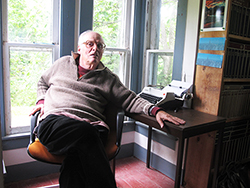
Mort Gellman of Holland, Vermont, stands next to one of his Honeycrisp trees. He manages a 100-tree apple orchard on his property. Photo by Natalie Hormilla

by Natalie Hormilla

copyright the Chronicle 9-5-2012

After a long, hot summer, people may be looking forward to fall foliage, cooler weather and crisp apple cider.  When the foliage will change or the weather cool is anyone’s guess, but at least one thing is certain:  This autumn’s apple crop won’t be nearly as bountiful as it was in 2011. 

“We had a lot of frost damage this spring,” said Mort Gellman, who manages an orchard of about 100 apple trees of ten different varieties on his property in Holland. 

Mr. Gellman, like many apple growers, was hit hard by the April frost that followed an unusually warm March. 

“Just when they were in full bloom, the temperature went down to 15 degrees,” he said.  “Yep, it was a big hurtin’.” 

Mr. Gellman sells his apples mainly through the Newport Farmers’ Market, and people are welcome to come pick their own.   

“I sold every apple I had,” Mr. Gellman said in reference to last year’s season. 

Some varieties fared better this year than others.  He estimates that he’s down about 75 percent on his crop of Cortlands, but only about 50 percent on his Honeycrisps.  His Rome Beauty tree, which is a very late bloomer, had its best year since he planted it three seasons ago. 

Mr. Gellman said the Rome Beauty is one of the finest baking apples, and it’s a variety from the 1800s. 

As of August 30, his apples weren’t ready for picking just yet.  His earliest variety, Zestar, had about one and a half or two weeks left before harvesting could start. 

Mr. Gellman planted all the trees himself, and takes care of them mostly by himself, sometimes with the help of a neighbor.  He turned 86 in August. 

“I’m not doing this to get rich,” he said.  “The orchard is my life.”

Mr. Gellman started working in apple orchards when he was 18 years old.  At one point in his life, he ran a large vegetable farm in his native New Jersey, where he planted 50 acres of tomatoes for the Campbell’s Soup Company.  He also worked on a 5,000-tree apple orchard in Missouri in the mid-90s. 

“I know enough about growing because that’s most of what I ever did,” he said. 

He isn’t alone in having fewer apples this year.  In fact, the apple crop for all of Vermont is forecast to be down about 28 percent compared to last year. 

According to the U.S. Department of Agriculture’s (USDA) National Agricultural Statistics Service (NASS), the state can expect to see a crop of about 24 million pounds of apples, down from last year’s 33.5 million pounds. 

The dip in statewide production mirrors a drop in national production for the year.  NASS has forecast that U.S. apple production will weigh in at 8,065.7 million pounds this year — about a 14 percent drop from last year’s 9,420 million pounds. 

Cate Hill Orchard in Greensboro also expects much less of a crop this year.

“I think we had a total crop failure, really, from that late freeze, or rather that early spring,” said Maria Schumann, who owns and operates the orchard withJosh Karp. 

Last year, Cate Hill Orchard had about 60 or 70 fruit bearing trees, Ms. Schumann said.  This year, about 20 of their trees bore fruit.  “And they all have way less than they had last year,” she said. 

Ms. Schumann cites the same reason as Mr. Gellman:  the April frost. 

“It’s a normal time to have that kind of freeze, it was more just that everything was three weeks ahead because of that warm weather in March,” she said.

According to the National Oceanic and Atmospheric Administration, this year’s March was the warmest ever for the U.S. since formal record keeping began in 1895.   Some states experienced warmer weather than others that month.  Vermont was one of the states to experience its record warmest March, along with the biggest apple producing states in the eastern half of the country, Michigan and New York. 

Cate Hill Orchard sold apples and cider at farmers’ markets in Hardwick, Montpelier and Stowe last year.  Ms. Schumann said they probably won’t do cider this year, except for by the glass maybe. 

Cate Hill Orchard has a mix of trees that are about 100 years old and were inherited from Mr. Karp’s family.  They also have much newer trees, for a total of about 250 trees.  Ms. Schumann said there is no real difference in production among the fruit-bearing trees in terms of their ages. 

“Last year was such a fantastic year,” she said.  “There were apples everywhere.” 

She said that last year’s bounty may also have something to do with this year’s dearth. 

“A lot of apples, not all, but especially heirloom varieties, will tend to have on years and off years.  They won’t bear the same amount every year, even without a frost.” 

Terry Bradshaw, president of the Vermont Tree Fruit Growers’ Association, also said last year’s big crop was a factor in this year’s smaller one.

“Last year was an incredible apple year in terms of quantity of fruit,” he said.  “Even maple trees had apples on them.”

Mr. Bradshaw said it’s prudent to manage an orchard so that spring buds are thinned to a number that doesn’t stress out the trees. 

“If you don’t, you’ll get what’s called biennial bearing,” he said, meaning that the trees will produce a big crop every other year, with little or no production on the off years. 

“So that’s kind of the one-two punch of why things might be a little bit lower this year,” he said.  “I noticed before the frost even came that the count of buds was low.”

Mr. Bradshaw makes the bulk of his observations at his home in Calais and on the orchard he manages for University of Vermont (UVM) Extension in South Burlington. 

He estimates that even without the frost, many trees that produced heavily last year would have only had about 70 percent production this year.  

Mr. Bradshaw explained that it’s in the apple trees’ best interests not to produce a lot of apples each and every year. 

“The only reason why any plant produces fruit is not to feed us, but to have a baby, to keep spreading the plant along,” he said.  “What the plant wants to do is make lots of those seeds, a lot of apples, and it wants to be fairly small so animals can spread them and it doesn’t mind not doing it every year because it breaks up pest cycles.  But the role of an apple grower is to grow big red apples every year, so we’re trying to steer nature in our direction.”

Biennial bearing may contribute to a lack of wild apples this year, which were in abundance in many areas of Vermont in 2011.

“A managed orchard has an annual crop,” Mr. Bradshaw said.  “Whereas wild trees, if they put all their resources out one year, they don’t mind taking a breather.”

Mr. Bradshaw said that state crop production has been variable.  He said the UVM Extension orchard is looking at about a half crop this year. 

“But I’ve heard of some growers saying they’re having their best year in recent memory, so it’s variable, and it depends on the varieties and when their blooms open,” he said.

“In Cabot there are maybe 3,000 trees in a fairly young orchard and they’re having their best crop ever,” he said.  “I’ve heard in the Eastern Townships they’re doing very well.  So there’s plenty of fruit.”  

“The economics of growing is interesting this year,” he said.  “If you’ve got fruit, you’re sitting in the driver’s seat, because all those packing houses and processors in west New York and Michigan have been driving to New England with checkbooks in hand trying to buy up fruit, and a lot of that’s for processing cider.”

“It wouldn’t surprise me to see $7 or $8 jugs of cider this year, so it’s good to be a grower.”

Mr. Bradshaw also said that those who did get fruit this year may find themselves with an especially good quality crop.  He said the sunny and warm weather has been complemented by just enough moisture to get the fruit to size.  

“I’m seeing larger fruit and redder fruit, because there hasn’t been a lot of cloud cover,” he said.  “The sun is what turns the apples red.”

Leaves turn solar energy into carbohydrates, which translates into a sweeter, higher quality apple, he said. 

“The other factor that turns apples red is cool nights,” Mr. Bradshaw said.  “Macs are classic with that, once you get nights in the 40s — and I think the weather is shifting and we’re going to come into the fall weather here.”

He pointed out that apple trees are grown all over the world, so they are very adaptable to different climates.  He said lack of rain and warm temperatures shouldn’t affect the trees. 

“The fruit buds are already set,” he said, referring to the middle of summer.  “If you get a drought in June, that would affect things.  The conditions that we’ve seen, I think we’ll have a good crop for next year.  Trees are adaptable, and they know that in August it dries up.  August is our least precipitous month every year, and all of the tree’s growth processes slow down by the middle or end of July because that’s how the tree’s programmed, to work with the systems we have.”

Chris Rawlings of Heath Orchard in Stanstead, Quebec, said that he’s seeing a crop of smaller quantity but higher quality this year. 

“It’s holding at about 65 percent of an average year,” he said.  “There are varieties which are better than usual in quality, not quantity.

“What I’m seeing on the MacIntosh is that, despite the fact that we had this event of frost on the blossoms, the apples that have come through for the most part are beautiful — round and have very little crevices and bumps for scab spores to install themselves, so they’re much prettier.  They’re an average size, no bigger, no smaller.  They’re looking good and they’re a reasonable size given the dryness.”

He said his Cortlands are looking particularly good as well.  The MacIntosh apples will start getting picked this Friday, September 7, which is early.

“We’re harvesting a week to ten days earlier than usual, across the board,” he said. 

Mr. Rawlings owns and operates the orchard with Lynn Heath.  They have 3,500 trees on 15 acres.  

Mr. Rawlings told the same tale as other growers — that the warm March followed by cold snaps accounts for most of this year’s lighter yield.  He said his Melba trees do take a breather every second year.

He also said that “micro micro climates” within his orchard account for some of the discrepancies he sees among his trees, even among the same varieties. 

“Nothing much is making a lot of sense, you know,” he said.

Still it sounds like Heath Orchard will have plenty of fruit to pick, as will most Vermont growers. 

Even though Vermont will see a significant drop in apple production, it’s still doing better than some other states.  Michigan — normally a top three apple producing state — is looking at a crop of 105 million pounds, as compared to last year’s 985 million pounds; New York is forecast to have 590 million pounds, compared to last year’s 1,220 million pounds. 

Washington — usually the apple producing leader of the country — is slightly up this year, at a total of 5,700 million pounds. 

NASS surveyed orchards of 100 or more bearing-age apple trees to gets its numbers.

For more free articles from the Chronicle like this one, see our Featuring pages. For all the Chronicle’s stories, pick up a print copy or subscribe, either for print or digital editions.

Share

Interview: Craftsbury’s Dave Bett wins Grammy Award

Dave Bett, design director at Columbia Records, sits in his Craftsbury home with his new Grammy award. Photos by Natalie Hormilla

copyright the chronicle July 11, 2012

by Natalie Hormilla

CRAFTSBURY — The public library here will have a special speaker on Wednesday night, July 11. Dave Bett, design director at Columbia Records in New York City, will give an informal presentation on the Bruce Springsteen box set The Promise:  The Darkness on the Edge of Town Story, for which Mr. Bett won a Grammy Award earlier this year.

He won the award along with his colleague, Michelle Holme, for the box set’s design. They won in the category Best Boxed/Special Limited Edition Package. The Grammy was a first for both designers.

Mr. Bett said that work on the box set took about three years to complete.
“A lot of it is research, anthropology, detective work, to find all the pieces that make the artist come alive,” he said.

The box set includes three CDs of music: one is the original 1978 Bruce Springsteen album, Darkness on the Edge of Town, and the other two consist of songs that didn’t make it on to that album. The set also includes three DVDs: one disc chronicles the making of the 1978 album, using footage shot by a friend of Mr. Springsteen’s at that time mixed with some new footage, and the other two discs are of live performances — one in 1978 in Houston, Texas, and another in 2009 in Asbury Park, New Jersey. The CDs and DVDs are housed in a facsimile of a blue, spiral bound Eagle Line notebook Mr. Springsteen kept while working on his fourth album leading up to its 1978 release, which is where Mr. Bett’s work really shines.

Mr. Bett and Ms. Holme created a sort of scrapbook of words by and images of Mr. Springsteen. They used snapshots, stills from videos, and copies of the many pages of lyrics, notes, lists and random thoughts Mr. Springsteen kept in the blue notebook while working on Darkness on the Edge of Town, his first album in three years after the 1975 hit Born to Run.

“This whole thing became about making an album, the creative process,” Mr. Bett said.
The box set version of the notebook looks a lot like the real notebook kept by Mr. Springsteen. It includes his scribbly handwriting, and realistic touches like the brown stains and random rips found in the pages of the original.

Mr. Bett said that real fans of The Boss will notice certain details in Mr. Springsteen’s notes, like lyrics that were moved to other songs in their recorded versions or that are missing entirely. There are also voting tallies of which songs should be in the album, and lists Mr. Springsteen kept of which songs and artists he was listening to at the time (Buddy Holly, Fats Domino, Elvis). These notes and lists are interspersed with photographs of Mr. Springsteen, chosen by Mr. Bett and Ms. Holme because they were either never used or seldom seen. Some of them are outtakes, and some of them are even stills from video footage, so that the images themselves did not even exist until the art directors at Columbia Records plucked them from old reels.

Pictured is a section of the Grammy-winning Bruce Springsteen box set The Promise: The Darkness on the Edge of Town Story. On the left page is a list Mr. Springsteen kept while working on his 1978 album, of songs that he was listening to at the time. On the right page is a working version of the lyrics to Badlands. The pages are part of a facsimile of the original notebook Mr. Springsteen kept, designed by Dave Bett and Michelle Holme of Columbia Records.

“I sat and watched maybe two full days of video from those days,” Mr. Bett said, “and saying ‘oop, keep that frame, keep that frame.’”

The box set is something meant to be pored over by Mr. Springsteen’s biggest fans, to leaf through and learn from. Mr. Bett said that, in designing the box set, he asked himself, ‘what would a fan want to see?’

“The funny thing about doing Springsteen stuff is being from New Jersey,” said Mr. Bett, who is a native of the Red Bank, New Jersey area, near the heart of Mr. Springsteen’s original Jersey fan base. “I can remember hearing about him playing at a high school gym, and everybody wanted to see him.” Mr. Bett was in seventh grade at the time, and was told he was not old enough to go.

He said his mother played pinochle with the mother of a kid in Mr. Springsteen’s band at that time, a connection Mr. Bett told Mr. Springsteen about while working together.
Over the years, Mr. Bett said, he has worked on four or five Springsteen projects through Columbia, some with Ms. Holme.

So what does it mean to be a design director for a record company? “All of the artwork for Columbia’s artists — the packaging — goes through me in some form,” Mr. Bett said, whether he assigns the work to someone else or not.

“Say if Columbia has a project, and we need to get a box set design for it, I’ll either say, ‘I’ll do it,’ or I’ll assign it to another art director.”

Mr. Bett said that each project begins with some sort of direction from the artist.
“Usually it means you talk to the artist about the title, what they might want to see — either a picture of themselves, or a cool illustration, or maybe they have no idea at all — then you find a direction that fits the music. Then you have to find the right photographer, the right people….”

Mr. Bett said that his job involves a lot of coordinating between people. “It’s about building the right creative team and overseeing that.”

Mr. Bett was nominated for a Grammy once before, in the same category, for his work on Tori Amos’ 2003 Scarlet’s Walk.

He lives in Long Island, New York, with his wife, Kate Bernhard. Ms. Bernhard’s mother, Nan Murdoch, owned the cottage near Craftsbury Common that Mr. Bett and Ms. Bernhard visit. They have been coming to Craftsbury since 1981.  “We feel like part of the community,” he said.

When they’re in Craftsbury, Mr. Bett said that he and his wife read a lot, and visit Caspian Lake in Greensboro and Bread and Puppet in Glover.

Mr. Bett also volunteers at the Craftsbury Public Library, where he’ll give his talk on July 11 at 7 p.m. He brought along his Grammy and an edition of the box set for the night.

contact Natalie Hormilla at natalie@bartonchronicle.com

Share

Profile: Margaret Pitkin’s Wild Blue Yoga

by Natalie Hormilla

Margaret Pitkin of Craftsbury strikes a pose — the mermaid — in her home studio. Photo by Natalie Hormilla

copyright the chronicle June 20, 2012

CRAFTSBURY — Even if you don’t take yoga classes around here, you’re probably familiar with Margaret Pitkin.  Maybe you grew up with her in Albany, or went to school with her at Lake Region, or maybe you’ve seen the many posters of her in various asanas — also known as yoga poses — in flyers of her tacked to local bulletin boards.

Those who do know Ms. Pitkin through yoga likely know another fact:  that she’s Vermont’s first and only fully certified Anusara yoga teacher — or she was, until she gave up her license in light of Anusara founder John Friend’s very public fall from grace earlier this year.

But to fully understand the significance of such a decision, let’s back up to the beginning.

Ms. Pitkin first got into yoga about ten years ago, while attending Smith College in Northampton, Massachusetts, where she was studying geology.

“I was pretty skeptical,” she said, of yoga.  “Growing up here, I wasn’t exposed to it.  I thought it was something for people from southern California.”

Ms. Pitkin, who has the limbs of someone you just know is disciplined, says she couldn’t touch her toes when she first started.  “People never believe me when I say that.”

She took classes from Deb Neubauer, a well-known yogini who taught in the Anusara style.

“So basically I did Anusara from the beginning,” she said.

After graduation in 2004, Ms. Pitkin returned home and began attending a yoga class at the Craftsbury library.  It just happened to be an Anusara yoga class.

After about a year of being home, she began traveling back to Northampton to study with an old philosophy teacher, which Ms. Pitkin considers a cornerstone of her approach to yoga.

The following spring, she drove to Los Angeles, California, to visit her sister, Roberta, and to attend a teaching workshop taught by Mr. Friend.

“That was my first time with John Friend,” she said.  “That made me feel really solid about Anusara, because I really liked him.”  She said he was very positive and good at making people feel comfortable.

When she got back to Vermont, her yoga teacher was pregnant and needed a substitute teacher.  Ms. Pitkin said she didn’t want to do it at first, because she didn’t feel qualified and was scared of speaking in public.

“But once I started doing it, I really liked it,” she said.  “It was easier than I thought to articulate my experience.”

She began training with Ms. Neubauer in Northampton regularly, and attending many teacher trainings and immersions all over the country.

“I’d fly to Miami, California, Arizona,” she said.  She said she spent “thousands of hours and tens of thousands of dollars,” to study and train to become an Anusara yoga teacher.

“Since 2006, I’ve spent about one weekend a month traveling to some sort of training, up until about the end of 2011,” she said.  “Which was right when some of this stuff started to come out.”

The “stuff” are the allegations made by many Anusara yoga teachers and community members against Mr. Friend since the short-lived website jfexposed.com launched earlier this year.  (The site has since been shut down.)  Some are sexual in nature:  that Mr. Friend had affairs with several of his female teachers, some of whom were married; and that he formed a “Wiccan coven” with several female teachers and employees.  Some are financial:  that he froze employees’ benefits plans and gave moneymaking opportunities to members of the “coven” over others.  And some are just unprofessional:  that he was forcing employees to personally accept deliveries of marijuana at his offices, that he was showing up ranting and unprepared to the teaching workshops that cost students hundreds of dollars a pop, that he was manipulating his better known teachers by withholding opportunities that only he could make possible.  The list goes on.

“When it first came out, I had a bad feeling about it, but I wanted to wait and see,” Ms. Pitkin said.

She said she had seen him publicly shame people at workshops and that she did feel his teaching had slipped from when she first began studying with him.  She said that if anyone spoke up, Mr. Friend would bully them out of the community.

“He had so much clout internationally.  If John decided he was going to promote you, you’re made,” she said.  “The way he set up the whole power structure of the whole thing, it was like if anybody had a problem with John, it was their fault.  Like, ‘you’re not really being open-hearted.’”

Ms. Pitkin formally resigned from Anusara in May.

The Anusara yoga school was founded by Mr. Friend in 1997, and has grown to have over 1,000 licensed teachers all over the world, according to anusara.com.

“I gave up my license, which means I can’t use the word ‘Anusara.’  Technically that’s all it means.  Which, if you think about it, is … ridiculous, because that’s the only thing I’ve ever studied,” she said.

Ms. Pitkin can still teach any other style of yoga.

“Anusara yoga was invented by John Friend, or at least, it’s credited to him, and then he made it into a corporation,” she said.  “So it was a business and a style of yoga.  He trademarked the name, the idea of the Universal Principles of Alignment.”

One of the defining traits of an Anusara class, as opposed to some other styles of yoga, is the touchstone of a philosophical theme woven into the approach to each class.

Ms. Pitkin says the philosophical component is one of the things that really drew her to Anusara.  She said the physical component is powerful, and that she’s even healed injuries with yoga, but that “it’s not the piece I find absolutely indispensable, for myself.  If someone said, ‘ok, you’re going to a desert island and you only get one practice,’ that’s probably the one I’d get rid of.  I’d bring my books.”

Asked how her classes have changed since leaving Anusara behind, Ms. Pitkin said, “I think that’s still in process.  There was a real community of arrogance in Anusara that I bought into.  Like, ‘I know so much, I’ve studied so much,’ like Anusara was the best style in the world.  There was this culture of ‘I’m the best’ and John really built it that way.”

“The main thing that’s changed for me is that I’ve lost my arrogance about what I know and do not know,” she said.

She said one student “felt like my presence as a teacher has changed.  She felt like I was more humble and more respectful of people’s experience.”

She said that yoga is about release, and that it helps you see more clearly, including yourself.  She said that the changes in her life before and after yoga have been extreme.

“I was really mean,” she said, laughing.  “I feel like I was pretty shut down.  I had a lot of defense mechanism-type walls up.  How I engaged with the world was to attack it.  The amount I’ve softened is amazing.”

It doesn’t sound like the end of Anusara is the end of her yoga practice.  “If anything, it’s going to get way better.  I’m going to get better.”

She said she wants to let her whole Anusara experience fall apart, “like compost.  In order for something from the past to be nutritious for the future, it has to dissolve.”

As part of her yoga studies, Ms. Pitkin has been in a two-year-long meditation course with Paul Muller-Ortega of Santa Barbara.  She studies Neelankantha meditation, which involves “listening to a lot of teleseminars on my iPod.”  She also studies philosophy with both Mr. Muller-Ortega and Douglas Brooks, who is a professor at the University of Rochester.  This is another facet of her yoga studies, which requires a lot of time and travel.

“It’s pretty much what I do in my free time,” she said.

She said the types of philosophy she studies “both could fall under the very broad category of nondual Hindu Tantra.  In a very broad sense, it’s the basic sort of belief that there is not a separation between matter and spirit.  That there’s really only one essential thing that’s making up everything.  That all the structures of the universe are working via that same essential power, or flow of energy, or however you want to put it.”

She said nonduality is about “pulling yourself out of the duality of life — pleasure and pain — and to not be at the whims of the roller coaster of life.”

Ms. Pitkin currently teaches seven weekly classes in Craftsbury, Burlington, Hardwick, West Glover and Morrisville.  She also teaches workshops in those towns as well as Montpelier.

She said that when she first started teaching she didn’t think supporting herself from full-time yoga would be possible.  “Because I mean, look where we live.  Where are the people that would take yoga class?”

She’s been able to teach full time since this winter.  In the summer, she does still work two days a week for Annerscaping, the landscaping company owned by Anners Johnson of Albany.

She used to work landscaping full-time while still teaching classes.  “It’s taken a long time to build up, to get my name out there basically.”

She says the reality of being a successful yoga teacher is a lot of time spent not teaching, but “working on my website, answering e-mails, trying to come up with descriptions.  A lot of the work is on the computer.”

“I love teaching,” she said.  “I get a little burned out on the constant e-mail — Internet thing, but teaching is not like work to me.  I get so much out of it.”

Ms. Pitkin lives in Craftsbury with her partner, Gabriel Tempesta.  She will turn 30 in August.

She plans on doing yoga for the rest of her life.

“I’ll definitely be like 90 and still teaching yoga,” she said.  “That’s my plan.”

She’s even got a name for her new style of yoga.  “I’m calling it Wild Blue Yoga, which is just a blend of what I’ve learned.”

contact Natalie Hormilla at natalie@bartonchornicle.com

Share