Interview: Craftsbury’s Dave Bett wins Grammy Award

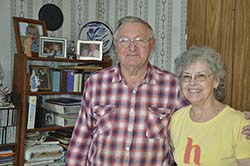
Dave Bett, design director at Columbia Records, sits in his Craftsbury home with his new Grammy award. Photos by Natalie Hormilla

copyright the chronicle July 11, 2012

by Natalie Hormilla

CRAFTSBURY — The public library here will have a special speaker on Wednesday night, July 11. Dave Bett, design director at Columbia Records in New York City, will give an informal presentation on the Bruce Springsteen box set The Promise:  The Darkness on the Edge of Town Story, for which Mr. Bett won a Grammy Award earlier this year.

He won the award along with his colleague, Michelle Holme, for the box set’s design. They won in the category Best Boxed/Special Limited Edition Package. The Grammy was a first for both designers.

Mr. Bett said that work on the box set took about three years to complete.
“A lot of it is research, anthropology, detective work, to find all the pieces that make the artist come alive,” he said.

The box set includes three CDs of music: one is the original 1978 Bruce Springsteen album, Darkness on the Edge of Town, and the other two consist of songs that didn’t make it on to that album. The set also includes three DVDs: one disc chronicles the making of the 1978 album, using footage shot by a friend of Mr. Springsteen’s at that time mixed with some new footage, and the other two discs are of live performances — one in 1978 in Houston, Texas, and another in 2009 in Asbury Park, New Jersey. The CDs and DVDs are housed in a facsimile of a blue, spiral bound Eagle Line notebook Mr. Springsteen kept while working on his fourth album leading up to its 1978 release, which is where Mr. Bett’s work really shines.

Mr. Bett and Ms. Holme created a sort of scrapbook of words by and images of Mr. Springsteen. They used snapshots, stills from videos, and copies of the many pages of lyrics, notes, lists and random thoughts Mr. Springsteen kept in the blue notebook while working on Darkness on the Edge of Town, his first album in three years after the 1975 hit Born to Run.

“This whole thing became about making an album, the creative process,” Mr. Bett said.
The box set version of the notebook looks a lot like the real notebook kept by Mr. Springsteen. It includes his scribbly handwriting, and realistic touches like the brown stains and random rips found in the pages of the original.

Mr. Bett said that real fans of The Boss will notice certain details in Mr. Springsteen’s notes, like lyrics that were moved to other songs in their recorded versions or that are missing entirely. There are also voting tallies of which songs should be in the album, and lists Mr. Springsteen kept of which songs and artists he was listening to at the time (Buddy Holly, Fats Domino, Elvis). These notes and lists are interspersed with photographs of Mr. Springsteen, chosen by Mr. Bett and Ms. Holme because they were either never used or seldom seen. Some of them are outtakes, and some of them are even stills from video footage, so that the images themselves did not even exist until the art directors at Columbia Records plucked them from old reels.

Pictured is a section of the Grammy-winning Bruce Springsteen box set The Promise: The Darkness on the Edge of Town Story. On the left page is a list Mr. Springsteen kept while working on his 1978 album, of songs that he was listening to at the time. On the right page is a working version of the lyrics to Badlands. The pages are part of a facsimile of the original notebook Mr. Springsteen kept, designed by Dave Bett and Michelle Holme of Columbia Records.

“I sat and watched maybe two full days of video from those days,” Mr. Bett said, “and saying ‘oop, keep that frame, keep that frame.’”

The box set is something meant to be pored over by Mr. Springsteen’s biggest fans, to leaf through and learn from. Mr. Bett said that, in designing the box set, he asked himself, ‘what would a fan want to see?’

“The funny thing about doing Springsteen stuff is being from New Jersey,” said Mr. Bett, who is a native of the Red Bank, New Jersey area, near the heart of Mr. Springsteen’s original Jersey fan base. “I can remember hearing about him playing at a high school gym, and everybody wanted to see him.” Mr. Bett was in seventh grade at the time, and was told he was not old enough to go.

He said his mother played pinochle with the mother of a kid in Mr. Springsteen’s band at that time, a connection Mr. Bett told Mr. Springsteen about while working together.
Over the years, Mr. Bett said, he has worked on four or five Springsteen projects through Columbia, some with Ms. Holme.

So what does it mean to be a design director for a record company? “All of the artwork for Columbia’s artists — the packaging — goes through me in some form,” Mr. Bett said, whether he assigns the work to someone else or not.

“Say if Columbia has a project, and we need to get a box set design for it, I’ll either say, ‘I’ll do it,’ or I’ll assign it to another art director.”

Mr. Bett said that each project begins with some sort of direction from the artist.
“Usually it means you talk to the artist about the title, what they might want to see — either a picture of themselves, or a cool illustration, or maybe they have no idea at all — then you find a direction that fits the music. Then you have to find the right photographer, the right people….”

Mr. Bett said that his job involves a lot of coordinating between people. “It’s about building the right creative team and overseeing that.”

Mr. Bett was nominated for a Grammy once before, in the same category, for his work on Tori Amos’ 2003 Scarlet’s Walk.

He lives in Long Island, New York, with his wife, Kate Bernhard. Ms. Bernhard’s mother, Nan Murdoch, owned the cottage near Craftsbury Common that Mr. Bett and Ms. Bernhard visit. They have been coming to Craftsbury since 1981.  “We feel like part of the community,” he said.

When they’re in Craftsbury, Mr. Bett said that he and his wife read a lot, and visit Caspian Lake in Greensboro and Bread and Puppet in Glover.

Mr. Bett also volunteers at the Craftsbury Public Library, where he’ll give his talk on July 11 at 7 p.m. He brought along his Grammy and an edition of the box set for the night.

contact Natalie Hormilla at natalie@bartonchronicle.com

Share

Profile: Margaret Pitkin’s Wild Blue Yoga

by Natalie Hormilla

Margaret Pitkin of Craftsbury strikes a pose — the mermaid — in her home studio. Photo by Natalie Hormilla

copyright the chronicle June 20, 2012

CRAFTSBURY — Even if you don’t take yoga classes around here, you’re probably familiar with Margaret Pitkin.  Maybe you grew up with her in Albany, or went to school with her at Lake Region, or maybe you’ve seen the many posters of her in various asanas — also known as yoga poses — in flyers of her tacked to local bulletin boards.

Those who do know Ms. Pitkin through yoga likely know another fact:  that she’s Vermont’s first and only fully certified Anusara yoga teacher — or she was, until she gave up her license in light of Anusara founder John Friend’s very public fall from grace earlier this year.

But to fully understand the significance of such a decision, let’s back up to the beginning.

Ms. Pitkin first got into yoga about ten years ago, while attending Smith College in Northampton, Massachusetts, where she was studying geology.

“I was pretty skeptical,” she said, of yoga.  “Growing up here, I wasn’t exposed to it.  I thought it was something for people from southern California.”

Ms. Pitkin, who has the limbs of someone you just know is disciplined, says she couldn’t touch her toes when she first started.  “People never believe me when I say that.”

She took classes from Deb Neubauer, a well-known yogini who taught in the Anusara style.

“So basically I did Anusara from the beginning,” she said.

After graduation in 2004, Ms. Pitkin returned home and began attending a yoga class at the Craftsbury library.  It just happened to be an Anusara yoga class.

After about a year of being home, she began traveling back to Northampton to study with an old philosophy teacher, which Ms. Pitkin considers a cornerstone of her approach to yoga.

The following spring, she drove to Los Angeles, California, to visit her sister, Roberta, and to attend a teaching workshop taught by Mr. Friend.

“That was my first time with John Friend,” she said.  “That made me feel really solid about Anusara, because I really liked him.”  She said he was very positive and good at making people feel comfortable.

When she got back to Vermont, her yoga teacher was pregnant and needed a substitute teacher.  Ms. Pitkin said she didn’t want to do it at first, because she didn’t feel qualified and was scared of speaking in public.

“But once I started doing it, I really liked it,” she said.  “It was easier than I thought to articulate my experience.”

She began training with Ms. Neubauer in Northampton regularly, and attending many teacher trainings and immersions all over the country.

“I’d fly to Miami, California, Arizona,” she said.  She said she spent “thousands of hours and tens of thousands of dollars,” to study and train to become an Anusara yoga teacher.

“Since 2006, I’ve spent about one weekend a month traveling to some sort of training, up until about the end of 2011,” she said.  “Which was right when some of this stuff started to come out.”

The “stuff” are the allegations made by many Anusara yoga teachers and community members against Mr. Friend since the short-lived website jfexposed.com launched earlier this year.  (The site has since been shut down.)  Some are sexual in nature:  that Mr. Friend had affairs with several of his female teachers, some of whom were married; and that he formed a “Wiccan coven” with several female teachers and employees.  Some are financial:  that he froze employees’ benefits plans and gave moneymaking opportunities to members of the “coven” over others.  And some are just unprofessional:  that he was forcing employees to personally accept deliveries of marijuana at his offices, that he was showing up ranting and unprepared to the teaching workshops that cost students hundreds of dollars a pop, that he was manipulating his better known teachers by withholding opportunities that only he could make possible.  The list goes on.

“When it first came out, I had a bad feeling about it, but I wanted to wait and see,” Ms. Pitkin said.

She said she had seen him publicly shame people at workshops and that she did feel his teaching had slipped from when she first began studying with him.  She said that if anyone spoke up, Mr. Friend would bully them out of the community.

“He had so much clout internationally.  If John decided he was going to promote you, you’re made,” she said.  “The way he set up the whole power structure of the whole thing, it was like if anybody had a problem with John, it was their fault.  Like, ‘you’re not really being open-hearted.’”

Ms. Pitkin formally resigned from Anusara in May.

The Anusara yoga school was founded by Mr. Friend in 1997, and has grown to have over 1,000 licensed teachers all over the world, according to anusara.com.

“I gave up my license, which means I can’t use the word ‘Anusara.’  Technically that’s all it means.  Which, if you think about it, is … ridiculous, because that’s the only thing I’ve ever studied,” she said.

Ms. Pitkin can still teach any other style of yoga.

“Anusara yoga was invented by John Friend, or at least, it’s credited to him, and then he made it into a corporation,” she said.  “So it was a business and a style of yoga.  He trademarked the name, the idea of the Universal Principles of Alignment.”

One of the defining traits of an Anusara class, as opposed to some other styles of yoga, is the touchstone of a philosophical theme woven into the approach to each class.

Ms. Pitkin says the philosophical component is one of the things that really drew her to Anusara.  She said the physical component is powerful, and that she’s even healed injuries with yoga, but that “it’s not the piece I find absolutely indispensable, for myself.  If someone said, ‘ok, you’re going to a desert island and you only get one practice,’ that’s probably the one I’d get rid of.  I’d bring my books.”

Asked how her classes have changed since leaving Anusara behind, Ms. Pitkin said, “I think that’s still in process.  There was a real community of arrogance in Anusara that I bought into.  Like, ‘I know so much, I’ve studied so much,’ like Anusara was the best style in the world.  There was this culture of ‘I’m the best’ and John really built it that way.”

“The main thing that’s changed for me is that I’ve lost my arrogance about what I know and do not know,” she said.

She said one student “felt like my presence as a teacher has changed.  She felt like I was more humble and more respectful of people’s experience.”

She said that yoga is about release, and that it helps you see more clearly, including yourself.  She said that the changes in her life before and after yoga have been extreme.

“I was really mean,” she said, laughing.  “I feel like I was pretty shut down.  I had a lot of defense mechanism-type walls up.  How I engaged with the world was to attack it.  The amount I’ve softened is amazing.”

It doesn’t sound like the end of Anusara is the end of her yoga practice.  “If anything, it’s going to get way better.  I’m going to get better.”

She said she wants to let her whole Anusara experience fall apart, “like compost.  In order for something from the past to be nutritious for the future, it has to dissolve.”

As part of her yoga studies, Ms. Pitkin has been in a two-year-long meditation course with Paul Muller-Ortega of Santa Barbara.  She studies Neelankantha meditation, which involves “listening to a lot of teleseminars on my iPod.”  She also studies philosophy with both Mr. Muller-Ortega and Douglas Brooks, who is a professor at the University of Rochester.  This is another facet of her yoga studies, which requires a lot of time and travel.

“It’s pretty much what I do in my free time,” she said.

She said the types of philosophy she studies “both could fall under the very broad category of nondual Hindu Tantra.  In a very broad sense, it’s the basic sort of belief that there is not a separation between matter and spirit.  That there’s really only one essential thing that’s making up everything.  That all the structures of the universe are working via that same essential power, or flow of energy, or however you want to put it.”

She said nonduality is about “pulling yourself out of the duality of life — pleasure and pain — and to not be at the whims of the roller coaster of life.”

Ms. Pitkin currently teaches seven weekly classes in Craftsbury, Burlington, Hardwick, West Glover and Morrisville.  She also teaches workshops in those towns as well as Montpelier.

She said that when she first started teaching she didn’t think supporting herself from full-time yoga would be possible.  “Because I mean, look where we live.  Where are the people that would take yoga class?”

She’s been able to teach full time since this winter.  In the summer, she does still work two days a week for Annerscaping, the landscaping company owned by Anners Johnson of Albany.

She used to work landscaping full-time while still teaching classes.  “It’s taken a long time to build up, to get my name out there basically.”

She says the reality of being a successful yoga teacher is a lot of time spent not teaching, but “working on my website, answering e-mails, trying to come up with descriptions.  A lot of the work is on the computer.”

“I love teaching,” she said.  “I get a little burned out on the constant e-mail — Internet thing, but teaching is not like work to me.  I get so much out of it.”

Ms. Pitkin lives in Craftsbury with her partner, Gabriel Tempesta.  She will turn 30 in August.

She plans on doing yoga for the rest of her life.

“I’ll definitely be like 90 and still teaching yoga,” she said.  “That’s my plan.”

She’s even got a name for her new style of yoga.  “I’m calling it Wild Blue Yoga, which is just a blend of what I’ve learned.”

contact Natalie Hormilla at natalie@bartonchornicle.com

Share