Lowell church gets a new steeple

Featured

Lowell Church Steeple 3

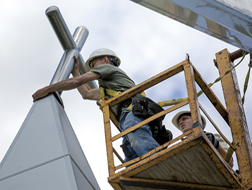
Omer Roberge (left) and stepson Brian Dodds top the new steeple of the Lowell Congregational Church with a new stainless steel cross on Saturday. Over 140 hours of work went into welding the cross, which was created by students at the North Country Union High School Career Center. Photos by Micaela Bedell

by Micaela Bedell

LOWELL — A new steeple was installed on Lowell’s 72-year-old Congregational Church building this past Saturday.

Open the doors of Lowell Congregational and you’ll find a large, diverse family, said member Becky Erdman at Saturday’s steeple raising.  But the congregation wasn’t always so big, and a new steeple wouldn’t have been possible without material donations and volunteer work from an influx of new members.

“It’s literally standing room.  We have to put chairs in the aisles,” said Mrs. Erdman of the 30- to 80-member increase in membership.

Verniece St. Onge, the longest participating member of the congregation at over 50 years, attributed the increase in membership to “young blood.”

“We’ve got a young family here with a new pastor,” she said.  “And a choir, which we haven’t had in years.  We’re just booming.  We’re full of life again.”

Mrs. St. Onge and others attribute recent membership increases to Pastor David Dizazzo.

“When this pastor took over full time there was just — I don’t know.  People were affected,” said new member Don Nolti.  “He’s a great Bible-believing, Bible-preaching pastor, which is what attracted me.”

The Lowell Congregational Church acquired a new steeple Saturday.  The process took more than four hours, and over 20 congregation members gathered to watch.

The Lowell Congregational Church acquired a new steeple Saturday. The process took more than four hours, and over 20 congregation members gathered to watch.

Lowell Church Steeple 5

A new steeple tops the Lowell Congregational Church.


Pastor Dizazzo, who gave his first sermon in the church on January 1, 2012, calls it more of a “right place at the right time” situation.  As he watched the beginning of the installation process, he mused on the symbolism of raising a cross higher onto the church.

“It’s very symbolic to us because, as a church, the goal is to lift Jesus higher,” he said.  “As we lift him up in our own lives, on top of the church is also this stainless steel cross.”

After a new church steeple was installed on Saturday, Lowell Congregational Church Pastor David Dizazzo embraces member Omer Roberge (left) in celebration.  Former Pastor John Genco’s wife, Ruth Genco, admires the steeple, and other members of the congregation clap for Mr. Roberge.

After a new church steeple was installed on Saturday, Lowell Congregational Church Pastor David Dizazzo embraces member Omer Roberge (left) in celebration. Former Pastor John Genco’s wife, Ruth Genco, admires the steeple, and other members of the congregation clap for Mr. Roberge.

Mrs. Erdman agreed that the cross is symbolic, but took it further.

“It’s a very modern cross going onto a very conservative church building,” she said.  “And [the combination] is going to work.  Because that’s exactly what’s going on inside.”

It took more than four hours to put up the new steeple Saturday morning.  It was done by congregation member Omer Roberge and his stepson Brian Dodds.  Over 140 hours went into welding the cross that topped the steeple, a product of North Country Union High School’s Career Center.  Instructor Roger Wells led seniors Ben Duranleau and Calvin Peacock and junior Paige Gagnon on the project.

Mr. Dodds constructed the base for the steeple, and roof brackets were donated by Guay General Repair and Steel in Newport Center.   Desrochers Crane Service in Derby also donated some time and equipment.

As the 170-year-old bell of Lowell Congregational rings to announce the new addition there are smiles all around.  The church has never had a steeple, but as eight-year-old Caleb Dizazzo put it, “This church was made for a steeple.”

For more free articles from the Chronicle like this one, see our Editor’s Picks pages.  For all the Chronicle’s stories, pick up a print copy or subscribe, either for print or digital editions.

Share

Lowell Six wind turbine protesters convicted of trespassing

Eric Gillard, the brother of one of the Lowell Six, holds a sign in front of the courthouse. Photo by Paul Lefebvre

by Paul Lefebvre

copyright the Chronicle 8-22-2012

NEWPORT — It took a jury of nine women and three men four hours to find wind opponents known as the Lowell Six guilty of unlawful trespass, following a one-day trial here in Superior Court.

The verdict appeared to reflect a trial in which a straight law and order issue trumped a disputed property boundary.

Conflicting testimony over the dispute may have confused the jurors as about an hour or so into their deliberation, they sent a note to the judge.

They wanted to know if there could be a legal owner when a property is in dispute.  And if the dispute was still current.

Trial Judge Martin Maley complimented the quality of the questions, but ruled each irrelevant.

“Do the best you can based on the evidence you heard,” he instructed them.

Disputed property boundaries were the key to the defense case:  If the state could not prove that the protesters were standing on property that was in the lawful possession of Green Mountain Power (GMP), then the defendants could not be convicted of unlawful trespass.

The prosecution argued that GMP was in lawful possession of the property, and that the protesters had broken the law when they refused to leave the land that had been posted by the company.

The trial was the first to be held involving protesters against the Lowell wind project that is being constructed by GMP.

Each of the six were arrested on December 5, 2011, when they refused police orders to leave posted property on Lowell Mountain while blocking the path of heavy construction vehicles.

Although the six presented their case as a group, the jury found each guilty as individuals.

Six more protesters are scheduled to be arraigned next month for a similar confrontation on the same mountain earlier this month.

Held Wednesday of last week, August 15, the trial was surprisingly silent on the underlying and highly charged issue that caused the defendants to break the law.  Before the jury entered the courtroom, Judge Maley warned he would only allow limited testimony on why the defendants were on the land.  And nothing, per se, on wind itself.

The jury, he said, knew what the case was about.  “It’s not a secret to them.”

So wind remained the elephant in the room:  the one everyone knew was there and agreed not to see.

Surprisingly, the only one to raise it as an issue was prosecutor Sarah Baker, when she sought to challenge the intent of the defense’s star witness, surveyor Paul Hannan of Calais, formerly of Holland and at one time a Kingdom legislator who served in the House.

Placed on the stand as an expert witness by defense attorney Kristina Michelsen, Mr. Hannan was prepared to provide the rock-bottom kind of testimony the defense needed to support its case.

Mr. Hannan testified that he had 31 years of experience as a surveyor and the credentials to qualify as an expert.  The rules of evidence, however, say that either side can challenge an expert’s witness.  And when her turn came, Ms. Baker proceeded vigorously.

First she asked Mr. Hannan about his association with Sterling College, and learned that during the years 1990 and 1991, he was one of the faculty members who accompanied students on three-to-four-day expeditions on Lowell Mountain.

The prosecutor pressed on.  Did he have any prior knowledge of Don Nelson — who allowed the students to use his property and who also is in a property dispute with GMP concerning the boundary line between his land on the mountain and the adjourning site where the utility is constructing its wind project.

No, said Mr. Hannan.

Ms. Baker may have thought she had found a chink in the defense’s armor when she abruptly asked the witness if he had any association with any anti-wind group.

Instead, the question brought a prompt objection from attorney Michelsen, along with a few hisses and murmurs from the 35 or so spectators in the gallery, a largely anti-wind crowd.

Judge Maley sustained the objection and Ms. Baker sat down, taking with her any references that the industrial wind project on Lowell Mountain had anything to do with the case.

There was a stirring in the closing moments of the trial when one of the defendants, Dr. Ronald Holland, took the stand.  The doctor’s name had surfaced earlier in the trial when Deputy Sheriff Phil Brooks testified for the state.

Of the ten protesters on the mountain that day, the deputy said he only knew Dr. Holland from previous personal and professional encounters.  He went on to testify that about two weeks prior to the December 5 confrontation, he received a call at home from Dr. Holland.  The doctor, according to the testimony, told the deputy he was going to the mountain that day to protest and wanted the deputy to arrest him.

“I informed him I was off duty and it wasn’t going to be me,” Deputy Brooks testified, adding that he passed what he characterized an “odd request” on to the State Police, who didn’t do anything either.

That testimony was before the jury when Dr. Holland took the stand late in the day.  The 67-year-old resident of Irasburg told jurors that days prior to the confrontation with police, he had gone onto the site and measured with twine the distance where he believed Mr. Nelson’s property ended.

And on the day of the confrontation, he testified he went to the limit of that measured distance.

But in a question that had nearly everyone in the courtroom leaning forward on the edge of their seats, Ms. Michelsen asked the emergency room doctor why he had climbed to the top of Lowell Mountain on December 5, 2011.

He paused and bowed his head a moment before answering that he had gone there to “protest the taking of Don Nelson’s property.”

Defendant David Rodgers, 69, of Craftsbury followed Dr. Holland to the stand and testified that he too believed he was on the Nelson property when police moved in to arrest him.

He testified that Dr. Holland had tied a block of wood to the end of a string as a means of measuring the property’s boundary.  And that he was “very careful not to” trespass on the land GMP is leasing to erect its 21-turbine wind plant.

The procession to the stand might have continued had not the prosecution agreed to stipulate that the remaining four defendants had followed the doctor’s lead.

But if the defense thought a protest over property rights could overturn the confrontation that followed, the jury saw it differently.  Nor did any witness refute or challenge the deputy’s testimony over what happened that day.

Deputy Brooks testified he received a call around nine that morning from GMP, informing him that protesters were on the mountain blocking heavy equipment from working on the wind project.  Police arrived roughly two hours later, and observed that the group was blocking cranes and big trucks.

“They were stopped on either side of where the defendants were,” he testified.

Deputy Brooks testified that prior to December 5, GMP had shown him a map of the project and its property boundaries.  And when confronting the protesters, he said he gave everyone the opportunity to step back behind the property line between GMP and the Nelson farm.

Of the ten protesters, three complied with a police order to step aside.  Six refused and were placed under what sounded like a gentleman’s arrest.  The deputy said he chatted cordially with the defendants and discussed everything but the project going on around them.

“I limited myself to that,” said Deputy Brooks.

The biggest problem police encountered that day, the deputy added, was finding a way to transport their prisoners off the mountain.

Police also arrested a seventh individual, Chronicle publisher Chris Braithwaite, who is challenging his arrest on grounds he was there doing his job as a reporter.

GMP’s intent to keep people off the site and the property it has under lease was deliberate and thorough, according to its project manager Charles Pughe, who also oversaw the posting.

“We cleaned out several stores,” he said, speaking of the no trespassing signs the company purchased.  “We had to have so many of them.”

Mr. Pughe testified that the land was initially posted for safety and to keep hikers out of harm’s way.  But he also noted that problems with people at the site began appearing sometime in October, as campers began to gather on the neighboring Nelson land.

Terms of the lease gave GMP authority to exclude or allow access to anyone the company chose, he said.

Mr. Pughe was off site the day the protesters were arrested.  But under cross-examination by Ms. Michelsen, he said, he could tell from photographic evidence — including photographs taken by the arrested journalist — that the protesters were on GMP’s leased property at the time of their arrest.

He estimated the face of the turbine would be about 200 feet away from the Nelson boundary line.

From the moment he took the stand it was evident that Don Nelson was not going to be a friendly witness.

He gave mostly monosyllabic responses to the prosecutor’s questions, and when asked to read a document, he shrugged and said he didn’t have his glasses.  That brought a query from the bench

“Need your glasses, Mr. Nelson?” asked Judge Maley.

“Don’t have them with me,” replied Mr. Nelson.

The prosecutor decided to try a different tack by asking the witness if he had given Dr. Holland permission to go on his property.

“My land is open.  People come and go,” he replied.  “I don’t invite or not invite.  We don’t post it.”

When Ms. Michelsen’s turn came to ask the questions, Mr. Nelson said that Dr. Holland had come to see him about the boundary dispute, and that he had provided him with the coordinates that were in disagreement.  According to his testimony, the dispute began years ago with the landowner who leased the land to GMP.  At the time, the witness testified, there was a difference of roughly 420 feet.

For its final witness, the state put on the surveyor who recently bought out a surveying business in Derby Line that surveyed the Nelson property several years ago in hopes of resolving the boundary dispute.

Andrew Nadeau testified that the previous owner had surveyed the property in dispute in 2007, and that he had spent in excess of two weeks surveying it as well.  But the surveyor who spent the longest time on the stand turned out to be the expert for the defense, Mr. Hannan.

Throughout his testimony, Mr. Hannan repeatedly testified there were fundamental mistakes in the 2007 survey — that affected the boundaries of lots leased by GMP.

He told jurors that in surveying the same ground, he found that markers had been inappropriately defined.  He said there must be corroborating evidence to define a marker or monument that had been used in the past when the land was first surveyed.  And such markers, he added, could be used to determine boundaries.

“When is a stone pile a stone pile or a monument?” he asked at one point.

Jurors already had heard from Mr. Nelson that surveying is not an exact science, and depends in part on the quality of surveys done in the past.  Mr. Nelson noted that he and his neighbor had tried to settle survey discrepancies on their abutting lands through an agreement.  Their boundary dispute was rekindled, however, when the agreement came unraveled.

Mr. Hannan testified that in surveying the land for the Nelsons, he found almost no markers on the ground that were left when the land was first surveyed in 1790.  And he told the jurors that the monuments defined by the 2007 survey were inaccurate.

Closing arguments were short, lasting about five minutes apiece.  Each attorney offered similar arguments to those they had made in their opening statements.

The verdict clearly took the defense and its supporters by surprise.  After asking the judge to poll each juror for a verdict, Ms. Michelsen said she would be filing post trial motions.  The court gave her ten days to submit them.

Prosecutor Baker said she would be requesting a restitution hearing, which means the state will try to convince the court to order the defendants to pay compensation to GMP.

The late hour verdict led the defendants to call off a press conference they had planned to hold at the conclusion of the trial.

In a press release Monday, Dr. Holland was quoted as saying:

“We are obviously disappointed with the verdict but respect the jury’s efforts. This is, and will continue to be, a complex case that rejects the simple and disingenuous offerings of Green Mountain Power.  We will continue to educate Vermonters on the science and math of ridgeline wind-generated electricity.”

As Mr. Pughe was walking away from the courthouse, he said he hoped the verdict would make his job easier.

The remaining four defendants of the Lowell Six are:  Ryan Gillard, 23, of Plainfield; Suzanna Jones, 50, of East Hardwick; Ann Morse, 48, of Craftsbury; and Eric Wallace-Senft, 46, of West Woodbury.

contact Paul Lefebvre at paul@bartonchronicle.com

For more free articles from the Chronicle like this one, see our Editor’s Picks pages.  For all the Chronicle‘s stories, pick up a print copy or subscribe, either for print or digital.

Share

Protesters stop Lowell turbine truck

A Lowell wind project protester confronts State Police Corporal Dan Kerin as he tries to clear people off Route 100 Monday. Opponents of the Green Mountain Power project stopped a truck hauling a section of a turbine tower for about two hours before a compromise was negotiated with police. Our story starts on page nineteen. Photos by Chris Braithwaite

copyright the Chronicle July 18, 2012

by Chris Braithwaite

LOWELL — Though it was billed as just a “rally” and an opportunity for opponents of the Lowell Mountain wind project to “greet the turbines” as they arrived, Monday’s confrontation here turned into a brief but intense exercise in civil disobedience.

Gathering across Route 100 from the gate to the 21-turbine wind project at 9 a.m., protesters seemed content to wave signs and sing songs that condemned the project.

But when a truck hauling a long section of turbine tower finally appeared, a handful of protesters rushed into the road and stopped it.  The quick arrest of two of them seemed only to draw others onto the highway in front of the idling truck.

Two Lamoille County deputies who had been hired by the project’s owner, Green Mountain Power, tried to “walk” the truck through the protesters, pushing them aside as they encountered them.  But that proved to be a futile exercise that one demonstrator described later as “herding an amoeba.”  Demonstrators flowed around the deputies to post themselves in front of the truck and bring it, once again, to a halt.

A group of Bread and Puppet performers had come to the scene in the Glover theater company’s distinctly painted bus, and their banners and fiercely beating drums brought fresh resolve to the protesters.  As the two deputies and uniformed security guards at the site stood by in frustration, the crowd chanted “Shame on you!” and “Turn it back!” at the bright red truck and its hapless driver.

As protesters line Route 100, watched closely by police officers, the turbine section finally pulls onto Green Mountain Power’s construction site.

It took some time for the first State Police officer to arrive.  And when Corporal Dan Kerin stepped out of his cruiser he encountered the same tactic that had confounded the deputies.  Each protester in turn yielded to the corporal’s direct order to clear the road, then stepped back onto the pavement when he moved on to the next protester.

But State Police officers started to arrive in force, backed up by Orleans County deputies and officers with the U.S. Border Patrol, Fish and Wildlife and VTrans.  Sets of hand restraints were brandished, and police dogs were sighted.  An onlooker who scouted the area on his bicycle reported counting 22 law enforcement vehicles at the scene.

Lieutenant Kirk Cooper, commander of the State Police Derby barracks, stepped into the middle of the crowd of demonstrators and appealed for a peaceful conclusion.

“You’re perfectly entitled to voice your non-support,” he told the demonstrators.  “But other people have to use this road.  That’s where we get in the middle.

“I’m not gong to give you a lot a crap,” the lieutenant continued.  If they didn’t move, he told the demonstrators, “we’re going to be forced to move you.  I honestly don’t want to do that.”

The officer’s plea was seconded by one of the Lowell project’s most determined opponents, Don Nelson.

“We’ve made our point, boys,” Mr. Nelson said.  “It’s time to back off.”

Some protesters heeded that advice, but some did not.  Police, gathered in a clump just beside the idling truck, seemed ready to move.  But leaders of the group were clearly anxious to avoid the confrontation that seemed moments away.

Pat Sagui, Steve Wright and Stephanie Kaplan, a lawyer who worked with opponents of the Sheffield wind project, talked to Lieutenant Cooper and Lamoille County Sheriff Roger Marcoux.

The deal they struck was that protesters would clear the highway if the sheriff released his two captives.  They were a key leader of the opposition, Ira Powsner, and his younger brother, Jacob.

Ira Powsner of Ira is placed under arrest moments after stepping out onto Route 100 to stop a truck carrying part of a wind turbine.

After they were issued citations to appear in court on September 11 to answer charges of disorderly conduct, the brothers stepped out of the sheriff’s vehicle to the cheers of protesters.  They sang “Happy Birthday” to Ira Powsner on the occasion of his twenty-sixth birthday.

The protesters returned to the side of the highway, the officers lined up to keep them there, and the truck finally hauled its long, white load through the gates and onto the construction site.

Watching from just inside that site, Lowell Selectman Richard Pion was less than pleased by the compromise.

“They ought to take half those people to jail,” he said.  If police lacked the vehicles to get them there, he added, “they should go get a school bus.”

“They can demonstrate, but there’s no need of blocking traffic,” Mr. Pion said.  “I thought this was the land of democracy,” he added, noting that a solid majority of Lowell citizens voted for the wind project.

Like most who tried to count the protesters, Mr. Pion estimated that there were about 100 of them.  “That shows there’s only a handful that’s opposed to this,” he said.

When traffic finally started to move past the Green Mountain Power gate, it consisted only of a handful of heavy trucks that had been held up in both directions, and one Army truck driven by what appeared to be a National Guardsman.  Most traffic was apparently able to drive around the obstruction on Mink Farm Road, which loops to the west of Route 100.

While Green Mountain Power’s chief executive, Mary Powell, was not visible at the scene, Vermont Electric Cooperative’s CEO, David Hallquist, was on hand.  His utility has agreed to buy a small share of the project’s power, at cost.

Asked by a reporter if he was upset by the demonstration, Mr. Hallquist replied that he would have been disappointed if no one had shown up.  Some of Mr. Hallquist’s remarks were recorded on film by his son, Derek Hallquist.  The younger Hallquist is working with the documentary filmmaker Aaron Woolf of New York State, whose best-known work is King Corn.

In the hard hat and safety vest provided by Green Mountain Power, Mr. Woolf and his crew were easy to mistake for employees of the utility.

Standing just inside the work site, facing the demonstrators across the road, Mr. Woolf noted that if people stood on his side of the road, they were pro-wind.  People on the other side of the road were anti-wind, he continued.

“And if you stand in the middle of the road, you get run over.”

The section of turbine tower had been held up on the highway for about two hours.  And as demonstrators headed north on Route 100 after the rally, they quickly encountered a second section of tower on its way to the site, closely followed by a long, slender turbine blade.

contact Chris Braithwaite at chris@bartonchronicle.com

Share