Publisher’s trespassing case dismissed

Featured

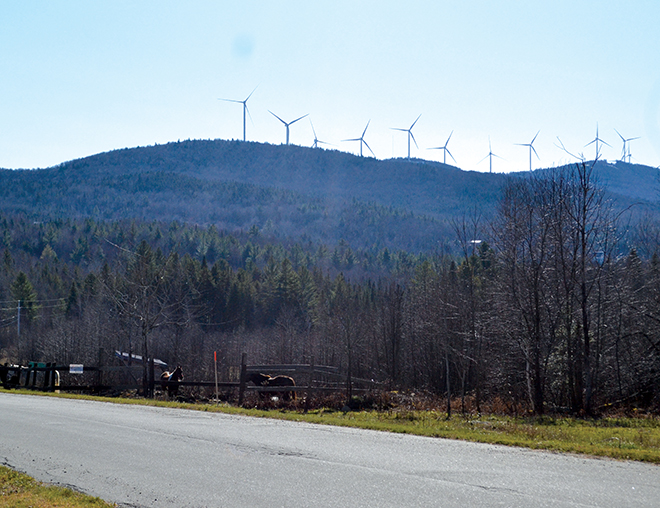
The Lowell Mountain wind towers as seen from Irish Hill. Photo by Bethany M. Dunbar

by Paul Lefebvre

copyright the Chronicle 12-12-2012

NEWPORT — A utility wind developer company that tried to do the right thing by the press appears to have shot itself in the foot when it allowed the arrest of a reporter and then failed to step forward and rectify an action contrary to company policy.

The Orleans County state’s attorney’s office last week dismissed a criminal charge of unlawful trespass brought against Chris Braithwaite, a reporter for and publisher of the Chronicle in Barton.

Mr. Braithwaite, who had been spearheading his paper’s coverage of the wind project on Lowell Mountain and the controversy it triggered, went to the site on December 5, 2011, to cover a demonstration that protesters had scheduled for the morning.

Police intervened and arrested six protesters, who became known as the Lowell Six.  A jury found each of them guilty of unlawful trespass this summer.  Mr. Braithwaite also was arrested despite his claims he only had gone to the site to cover the demonstration as a reporter.

When news of his case’s dismissal was announced last week, Mr. Braithwaite, 68, of West Glover, released the following statement:

“On the day after my arraignment on a charge of unlawful trespass, I wrote that I believed my conduct on Lowell Mountain on December 5, 2011, satisfied the dictates of common sense and the ethics of journalism.  What remained was the daunting task of demonstrating that it was also within the law.  That task came to a successful conclusion today.”

Dismissal came as the case was preparing to go to trial and after defense attorney Phil White subpoenaed internal e-mails that passed back and forth among officials of Green Mountain Power Company (GMP.)

The documents show that GMP intended to give Mr. Braithwaite and other reporters access to its Lowell Mountain site, where protesters were demonstrating against the construction of a 21-turbine wind project.

“Does anyone know what happened,” asked Robert Dostis, a GMP official who works with communities and who was responding to colleagues about an editorial against the arrest.

To GMP’s site manager at Lowell Mountain, he went on express surprise that an arrest had occurred.

“Frankly, I don’t understand why Chris was arrested since you gave exact instructions that he not be,” he wrote in an e-mail dated December 10.

A day later, a second official struck a similar note.

“I think now we have to put an end to the notion we tried to stop the media, when we simply did not,” wrote a GMP consultant Stephen Terry in an internal e-mail sent six days after the arrest.

He then repeated a question asked earlier by the company’s public relations officer:  “Did the leadership instruction not to arrest CB just not get relayed fast enough Monday morning?”

While release of the e-mails helped to end the criminal charge, they may have opened a new chapter in the case.

Attorney White said Monday he had asked for an apology from GMP as well as compensation for expenses and legal fees that came to $22,330.

“Had Green Mountain Power disclosed this information to the State Attorney’s Office promptly, Chris never would have had to undergo a year facing criminal charges,” wrote Mr. White in an e-mail.

“Instead, GMP sat on its hands and did nothing, absolutely nothing.”

Mr. White said he hoped that GMP would “do the right thing” by apologizing and paying Mr. Braithwaite.

But that appeared unlikely Tuesday.

GMP Public Relations Officer Dorothy Schnure said that it was Mr. Braithwaite’s refusal to leave the site that caused him to be arrested.  And once an arrest occurred, it was out of GMP’s hands.

“It’s not our case, it’s the state’s,” she said, adding later:  “While we had hoped he wouldn’t be arrested, that’s what played out.”

She declined to comment Tuesday if the company had received Mr. White’s request of GMP to pay for his client’s legal fees and expenses.

In an e-mail later in the day Ms. Schnure stated:

“Frankly, the proposition that David Coriell acted inappropriately and that it gives grounds for a legal claim by Chris Braithwaite is frankly frivolous.”

On Monday Judge Howard VanBenthuysen, who presided over the case, released some of the documents, which had been sealed under an agreement between the defense and prosecution.

The judge noted they had been submitted in support of the defense motion to dismiss with prejudice and were now part of the public record.

He also said he would not rule on the motion to dismiss the case with prejudice until the state had a chance to respond.  If a case is dismissed without prejudice, the state can bring it again.  He set a deadline of December 26 for the prosecution to respond.

Deputy State’s Attorney Sarah Baker said in an interview Tuesday she would file a response opposing the motion because there is still evidence available that would enable the state to win the case.

She said her motion would also explain why the state dismissed the charge, adding that her office did not want to inconvenience a witness and former employee of GMP who has since moved from Vermont.  Ms. Baker also said there were documents in the file that had not been unsealed and that would help the state prove its case, in the event it was brought back.

The documents that came to light this week indicated that the state’s dismissal may have hinged on the failure of a GMP employee at the scene on the day of the arrest to correctly inform police officers of the company’s policy toward arresting Mr. Braithwaite and any other journalists covering the protest.

As GMP officials scrambled to learn what had happened, David Coriell, its representative at the site during the protest, tried to explain to his bosses in two e-mails why the arrest had occurred.

The first e-mail sent on the day of the arrest stated: “Braithwaite and another woman stopped at the edge of the construction site and started taking pictures.  Phil Brooks, the Orleans Co. Chief Deputy, asked Braithwaite and the woman to get back another 50 feet to the Nelson property.  The woman complied.  Braithwaite chose to stay.  Brooks approached Braithwaite and after a short conversation he asked him to leave or come back and stand with those willing to be arrested.  Braithwaite walked back and stood with those being arrested.”

In the second e-mail, dated December 11, Mr. Coriell told his bosses that the no-arrest instructions “didn’t get relayed to all the officers involved.

“That said, I know the Sheriff had no intention of arresting Chris.  Chris actually arrested himself by physically walking back to the middle of the crane path.”

He went on to say that Mr. Braithwaite called the officer an expletive.  The officer charged that the reporter had stepped “over a professional line.”

Ms. Schnure said Tuesday the scene that day at the site was confusing, with cell phones losing signal and people milling around.  She called the arrest Tuesday “a breakdown in communications.”

Concerned that another protest at the mountain was coming, GMP officials huddled and considered what they should do about access and the press, and what instructions to give the police.  An e-mail from Ms. Schnure to GMP managers on December 11 laid out a possible course of action.

“Dave confirm that sheriff will be there early if at all possible.  Ensure sheriff knows media has permission to be there.  Tell Sheriff we really don’t want any reporters arrested.”

Mr. Terry, the consultant, agreed, calling the proposed instructions “a good way to pre-empt another journalism arrest which was never our intent or purpose here.”

While it is still unclear how far the documents went in convincing the state to dismiss the charge, they did provide a picture of GMP managers working to ensure similar arrests of reporters would not occur at future demonstrations.

“We have to minimize the public and political fallout of decisions made on the mountain,” wrote Mr. Dostis in a December 10 e-mail.

“Arresting reporters will do more harm than good.”

Ms. Schnure said repeatedly Tuesday that it was Mr. Braithwaite’s actions that caused his arrest.  And that he was not owed an apology by GMP.

contact Paul Lefebvre at paul@bartonchronicle.com

For more free articles from the Chronicle like this one, see our Editor’s Picks pages. For all the Chronicle’s stories, pick up a print copy or subscribe, either for print or digital editions.


Share

Braithwaite trespassing charge dismissed

Chronicle publisher Chris Braithwaite issued the following statement after his trespassing charge was dismissed today (December 5):

On the day after my arraignment on a charge of unlawful trespass, I wrote that I believed my conduct on Lowell Mountain on December 5, 2011, satisfied the dictates of common sense and the ethics of journalism.  What remained was the daunting task of demonstrating that it was also within the law.  That task came to a successful conclusion today.

It is my hope that journalists who find themselves in a similar situation will bear this case in mind when they are ordered to leave the scene of important public event.

And I hope that police officers will bear this case in mind, when they encounter journalists at the scene of significant public events who are just trying to do their job.

I regret that the documents which would help to explain the state’s decision to dismiss my case remain under court seal.  The Chronicle has asked the court to release these documents, and I hope that my colleagues in journalism will join me in an effort to make this information public.

Below is the story that ran in the newspaper this week (printed in the morning just before the case was dismissed):

by Paul Lefebvre

copyright the Chronicle December 5, 2012

NEWPORT — A jury has been picked for the trial of Chronicle publisher Chris Braithwaite who was arrested as a reporter covering a wind protest on Lowell Mountain roughly a year ago.

The trial is scheduled to start next week on Thursday, December 13, and is expected to last a day.

The trial’s start-up date may be delayed due to a motion filed Tuesday by defense attorney Phil White, asking the charges be dismissed for lack of evidence.

The evidence offered in support of the motion has been largely redacted as a result of the court’s protective order on internal GMP documents subpoenaed by the defense.

Mr. Braithwaite, 68, of West Glover is accused of unlawful trespass for allegedly refusing to obey a police order to leave a mountaintop site while covering demonstrating protesters on December 5, 2011.

Known as the Lowell Six, the protesters were demonstrating against a 21-turbine wind project being built by the utility Green Mountain Power (GMP).  A jury this summer found each of the protesters guilty of unlawful trespass.

Mr. Braithwaite was arrested on the same day and at the same place as the protesters.  But the two cases went their separate ways over an issue whose resolution still remains uncertain.

Presently pending before the court is the issue of whether Mr. Braithwaite will be tried as a private citizen or as a member of the working press who was arrested while doing his job.

Since his arraignment last December, Mr. Braithwaite has asserted that he had only gone to the mountain that day to do his job as a reporter.

Early in the case, Mr. White tried to get the charge thrown out on constitutional grounds, arguing that Mr. Braithwaite had gone to the mountain as a journalist “to cover a protest.”

And as a member of the working press he “should enjoy a special right and privilege under the First Amendment of the United States Constitution to cover protest on private property and the government response,” argued Mr. White.

Mr. White was unable to cite any case law in support of his privilege argument and his motion failed.

“There is no legal authority” that gives a member of the working press “privilege to trespass on private property,” wrote Judge Robert Gerety Jr.

Last week, however, the argument was rekindled as both sides prepared for trial before a new judge who recently began his term in Orleans County Superior Court.

Judge Howard VanBenthuysen is expected to rule on a motion this week that will determine if jurors will get to hear defense arguments that a working reporter has special privileges when it comes to gathering news.

Mr. White has put the names of two Northeast Kingdom journalists on his witness list:  Ross Connelly, publisher of the Hardwick Gazette; and Robin Smith, a reporter for the Caledonian-Record.

The state, in turn, has asked the court to strike the two journalists from the list.

Prosecutor Sarah Baker wrote in her motion that neither individual “was a witness present at the time of the offense.”

A deputy state’s attorney with the county, Ms. Baker has asked the court “to exclude any witness whose testimony is offered solely as evidence of a privilege or right of press to be on private property without permission to report on a state response.”

While the judge’s decision is still pending, he did allow Mr. White during last Friday’s jury draw, November 30, to question prospective jurors over how they view the press’s role in a democracy.

For example, the defense attorney asked one juror how important it is for the press in a democracy to report the news.

“I feel strongly that the press have an important role in the democratic process,” she replied.

One juror said she often found the news coverage “very biased.”

But another who was the subject of a news story disagreed.

“They wrote what they saw fit, and I liked what they did,” he said.

Support among members of Mr. Braithwaite’s profession has been slight, with the exception of two Northeast Kingdom newspapers.

Mr. Connelly, who publishes the Hardwick Gazette, spoke out strongly immediately after the arrest in an editorial that said the press must have access if it is to report the news.

“Had Braithwaite not been at the protest site, the press would not have been able to report on the behavior of the protesters or the… police enforcing a public trespass order, sanctioned by the state courts and enacted by the State legislature.”

Mr. Connelly ended the editorial by saying officials were undermining the democratic process “when they sanction the arrest of journalists for doing their jobs.”

Vermont Press Association Executive Director Mike Donoghue acknowledged in an e-mail Tuesday that the arrest could have a chilling effect on the ability of the press to gather news.

“The press has the responsibility to report the news as it happens,” he said.  “The public, who can’t always be present, expects us to be their representatives monitoring government in action.  And that is a privilege.”

Caledonian-Record publisher Todd Smith suggested in an interview last Friday that regional bias may have played a role in the lack of attention the case has received.  He said around the state the Northeast Kingdom is seen as the “red-headed stepchild” and that the Vermont media in general were “a little busted” as a professional organization.

“I support Chris’s principles in going after this, and avoid agreeing to any plea,” said Mr. Smith.  “Journalists have to get access to a site and bear witness to do their job.”

Questions about access to the site and GMP’s role with the press may come to light during the trial, or even sooner.

Last week the court signed a protective order that allows only the prosecutor and the defense to see confidential communications between GMP and others regarding the Lowell Mountain project.

Among other communications, the material to be examined includes documents and internal e-mails created between September 1, 2011, and January 31, 2012, pertaining to “press access or arrest of trespassers on the Project property.”

As a result of the defense request, GMP is required to turn over any documents mentioning Mr. Braithwaite or the Chronicle.

Mr. Braithwaite editorialized repeatedly against the project in his paper.  According to the protective order, GMP received the paper during the September and January time frame.

What the documents and e-mails say may be revealed if Mr. White prevails in his pre-trial motion to dismiss the charge against his client.

“Based on their obvious relevancy and the lack of any corporate interest to keep them sealed, we would respectfully request that they be unsealed by order of the court,” he wrote in his latest motion that was filed this week.

That request exists alongside with another, asking for a pre-trial evidentiary hearing in which GMP officials would be required to give testimony.

The attorney also renewed an earlier argument that dismissal of the charge would be in the interest of justice.

contact Paul Lefebvre at paul@bartonchronicle.com

For more free articles from the Chronicle like this one, see our Editor’s Picks pages. For all the Chronicle’s stories, pick up a print copy or subscribe, either for print or digital editions.

Statement from attorney Phil White, Esq.:

I’m pleased and thankful that this case has been dismissed by the Orleans County State’s Attorney’s Office.  Anytime a reporter is arrested while covering the government’s arrest of protesters, it is a serious matter.  It raises fundamental concerns about the freedom of the press to act in its constitutionally recognized role as The Fourth Estate.

We have argued that when property rights clash with First Amendment Rights of the working press (particularly when it is acting as the Fourth Estate covering transactions of government), a balancing test should be applied (as it often is when constitutional interests collide).  That issue will not be reviewed in this case any further.   Chris Braithwaite and The Chronicle, to their credit, were fully prepared to seek review of any conviction by the Vermont Supreme Court and even The United States Supreme Court.   It has been an honor to represent him.  And, I hope this discussion will continue.

Share

Lowell wind project nears completion amid noise complaints

Featured

The Lowell Mountain wind towers as seen from Irish Hill. Photo by Bethany M. Dunbar

by Chris Braithwaite

copyright the Chronicle 11-28-2012

LOWELL — All 21 turbines of the Kingdom Community Wind project have generated power, a spokesman for Green Mountain Power said Tuesday.  And with the project making power, it has beaten the December 31 deadline to qualify for federal production tax credits that should total between $40-million and $48-million over the next ten years, said the spokesman, Dorothy Schnure.

She emphasized that “every penny” of the tax credits “goes to lower the cost of power for our customers.”

Ms. Schnure stopped short of saying the project is complete.  “We still have some fine tuning work to do on them,” she said of the turbines.

Meanwhile complaints about noise continue to be heard from the project’s neighbors.  And the distances the turbines’ sound can travel continues to surprise people.

Mary Davis, who lives about four miles east in Albany, across the valley of the Black River and a little east of Page Pond, said she heard them early Monday morning.

“I was taking the old dog out for a three o’clock stroll,” Ms. Davis said.  “She’s almost 15, and when she’s got to go, she’s got to go.”

Ms. Davis found the sound novel, but hard to describe.  “It was just something different,” she said.

“It must be awful” for the project’s close neighbors, Ms. Davis commented, “if you can hear it this far back.”

On the other side of Lowell Mountain, on the Farm Road, one such neighbor arrived home from his overseas job late last week.

“At approximately 3 on the morning of November 25 I along with four of my house guests were woken by thumping noise that lasted for over two hours coming from the wind turbines behind my home,” Kevin McGrath wrote in an e-mail to Susan Paruch, a consumer affairs specialist at the state Department of Public Service.

“The noise was similar to a heavy object rotating in a clothes dryer,” Mr. McGrath wrote.  “Later on that morning at about 10 the noise levels penetrated my home and sounded like a waterfall gushing directly behind my home.”

Mr. McGrath lives in one of about 50 structures that sit inside a “1.5 mile buffer” drawn around the project by RSG, Inc., the White River Junction firm that drafted the final sound monitoring protocol for Green Mountain Power.  His home is also one of about 19 structures within a smaller zone where, RSG estimates, turbine sound will reach between 40 and 45 decibels outside the home.

In granting the project a certificate of public good, the state Public Service Board set sound limits at 45 decibels outside neighboring homes, and 30 decibels in their bedrooms.

The extended family of Don and Shirley Nelson celebrated Thanksgiving in their farmhouse, which also sits well inside the 40-to-45-decibel zone.

Among the 19 people present, Mr. Nelson said Monday, two suffered migraine headaches, and some thought their ears were going to pop.  “Some of their stomachs didn’t feel right,” Mr. Nelson said, “and I don’t think it was Shirley’s cooking.”

“Shirley can hear it in the house,” he said of the turbine sound.  “Her ears are ringing all the time now.  They never did before.  If we go away two or three hours, it stops.”

Mr. Nelson, who was one of the migraine sufferers, said it’s impossible to know what causes such a headache.  He added that he expects complaints from his household to be discounted by Green Mountain Power and state officials, because the couple has fought to stop the project since it was proposed.

At Green Mountain Power, Ms. Schnure said the utility has received two more noise complaints since a particularly noisy weekend surprised many Albany residents in early November.  Both of the recent complaints came from hunters, she said.

“If people have concerns about undue noise they should talk to us,” Ms. Schnure said.

The Public Service Board imposed strict noise limits on the project, she said, “and we will meet those standards.”

contact Chris Braithwaite at chris@bartonchronicle.com

For more free articles from the Chronicle like this one, see our Editor’s Picks pages. For all the Chronicle’s stories, pick up a print copy or subscribe, either for print or digital editions.

Share

Tractor-trailer with turbine tips over

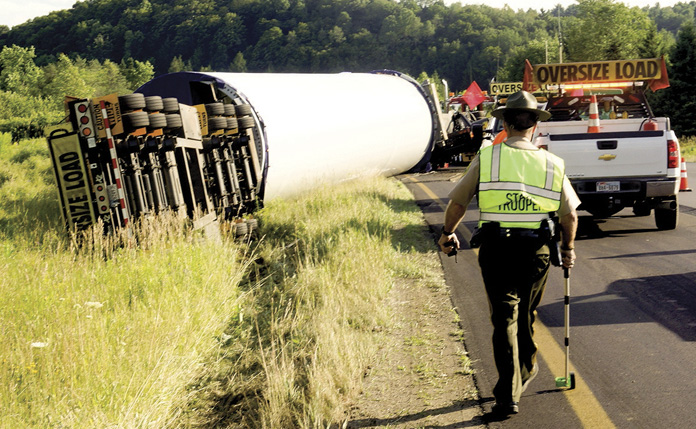
A state trooper measures the length of the path the upended trailer’s wheels made in the roadside grass. Photos by Chris Braithwaite

copyright the Chronicle July 25, 2012

by Chris Braithwaite

The bottom section of a massive wind turbine bound for Green Mountain Power’s Lowell Mountain project tipped over Thursday, July 19, when it encountered a paving crew on Interstate 91.

The interstate was closed to southbound traffic for about three hours Friday morning while a crane retrieved the long white tube from the ditch and put it on a truck.  The load made it to the job site on Route 100 south of Lowell Village just before noon on Friday, according to Phil Brooks, chief deputy of the Orleans County Sheriff’s Department.

The highly specialized tractor-trailer, owned by Lone Star Transportation, was in the passing lane, just north of the Orleans exit, when a left rear tire left the pavement and hit soft ground.  Tire marks in the roadside grass indicate that what followed must have been an agonizingly slow catastrophe.  The marks moved ever further from the pavement, ever lower down a gentle slope for 500 feet until they came to the trailer, its rear wheels overturned in the ditch.  The tractor remained upright.

Speed was not a factor, State Trooper Rajesh Hailey said in his press release, and the driver, Jimmy Maddox of Gainesville, Texas, was not hurt.

Deputy Brooks said a crane was immediately dispatched from Desrochers Crane Service in Derby.  It was unable to lift the tower section, but did assist a larger crane that arrived early Friday from Massachusetts, Mr. Brooks said.  The interstate was closed at about 8 a.m. to allow space for the big crane to set up.  Once that was done, Mr. Brooks said, it took only half an hour to recover the tower section.  The highway was reopened at about 11 a.m.

A section of a wind turbine destined for Lowell Mountain rests in the ditch beside Interstate 91, just north of the Orleans exit.

Under the terms of its permit and state law governing overweight loads, Mr. Brooks said, Green Mountain Power’s contractor can use the highways from half an hour before sunrise to half an hour after sunset.  However, loads must lay over in a “safe haven” between 7 and 8 a.m., noon and 1 p.m., and 4 to 5 p.m., Mr. Brooks said.  Thursday’s load had just pulled out of the Coventry rest area when the accident occurred a few miles south, at 5:16 p.m.

Opponents of Green Mountain Power’s project, who held up a truck for about two hours on July 16, may continue to try and block the loads.  The Mountain Occupiers, a group that has spearheaded several acts of civil disobedience in opposition to the project, scheduled a “civil disobedience training” in Craftsbury on Tuesday evening, July 24.

In an e-mail announcing the training, the group said:  “As our powerful actions blocking the turbine trucks in Lowell showed, our cause can draw crowds, media, support, and even negotiate with the law.  We don’t have to be bystanders to the destruction of our state.  The time for action is now!”

Two protesters were arrested on July 24 after they stepped in front of a truck just before it turned into the Lowell site.  They were cited for disorderly conduct, but released from custody after negotiations with police in which protesters agreed to clear the highway.

contact Chris Braithwaite at chris@bartonchronicle.com

For more free articles from the Chronicle like this one, see our Editor’s Pick page.  For all the Chronicle‘s stories, pick up a print copy or subscribe, either for print or digital.  

Share

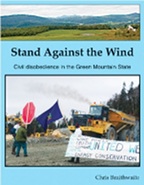
Stand Against the Wind tells wind protesters’ stories

Stand Against the Wind:  Civil Disobedience in the Green Mountain State by Chris Braithwaite, Chronicle Inc., Barton, Vermont.  2012, 110 pages, softcover, $19.95.

Reviewed by Julia Shipley

copyright the chronicle May 23, 2012

No matter where you stand on the issue of installing 21 commercial wind turbines atop the Lowell mountains in Vermont’s Northeast Kingdom, whether you bristle and grieve or feel triumphant or resigned, whether you live here, in Orleans County, or in Atlanta, Georgia, whether you have been doggedly following news of the mountain occupancy or whether you feel exhausted at the very mention of the word “issue,”— whomever you are, you might find an endangered pleasure in this new book, Stand Against the Wind by the Chronicle’s co-founder and publisher, Chris Braithwaite. Those pleasures include both a textbook example of old school, shoe leather journalism built of substantiated assertions and meticulous reporting and the smithing of that information into about 2,000 utterly gorgeous sentences. One right after the other, his narrative travels in boxcars of strong, clear prose driving each of the book’s 27 chapters, and making a collective portrait of civil disobedience committed by six individuals.

The book begins with a symbolic and actual dividing line on top of Lowell Mountain.  As Braithwaite analyzes what the actual plastic tape-line divides, his litany of things divided, and the disparities presented, culminate in this lovely sentence:  The bright orange tape is a line “between a place that is so high, so cussedly strewn with deadfalls and moose shit that nobody goes there except to hunt and hike, each winter for many years to enjoy the near-wilderness experience of camping in the snow; and a mountain so convenient that a guy can drive his pickup to the top just to check the oil on a multimillion dollar machine.”

This first editorial chapter (originally published in the Chronicle) invites us to “risk feeling that you are being torn in two…up where the blasting will soon begin.”

For those of us who did not accept that invitation, the Chronicle has consistently covered the issue for months, and even years.

Although the book encompasses some key events leading up to the commencement of Green Mountain Power’s project to install industrial wind towers on one of Vermont’s northernmost ridgelines, what Braithwaite calls “a wonderful sort of nowhere, ” the book takes for its subject the actions of some concerned citizens to stop it from happening. Like a club sandwich, the book is not just lettuce and cheese, the names and the dates, the he said, and she said. There are other layers interspersed, and the meat of this feast is really found in the in-depth profiles of a half dozen protestors, whom we meet one at a time, the six people most consistently involved with using “direct action.”

“Who cares?” and “Why do they care?” But more importantly: “How do they care?” — this exploration of what care-in-action looks like, of how to gracefully express distress is certainly pertinent to everyone. For even industrial wind tower proponents surely have, at one time in their life, experienced a feeling of powerlessness against a larger force usurping and/or annihilating, something they love.

Stand Against the Wind introduces us to these complicated, intelligent, thoughtful, people, who resist the paralysis of despair and flex that constitutional right we’ve all been guaranteed: the right to express our dissent.

As we learn in the fourth chapter, this expression is first modeled by Anne Morse, who explains to Braithwaite, “The point isn’t getting arrested. The point is the direct action that leads to the arrest. I think that it highlights the problem… people coming together collectively to highlight something that’s happening that’s wrong.”

Subsequent chapters feature profiles on Dr. Ron Holland, Eric Wallace-Senft, David Rodgers, Suzanna Jones, and Ryan Gillard. These interviews feel intimate, as Braithwaite allows each person to articulate the life circumstances and experiences that informed their actions on the Lowell Mountains. Their testimony is so unadulterated, it’s as if we’ve been given access to the inner thoughts, to their minds shifting, reorganizing, each building to his or her own truth. Whereas David Rodgers comes to his decision to protest thorough an increasing urgency realized in an intuitive way, confessing “It’s not something I did methodically, it was more a sense that I need to take a stand,” for Dr. Ron Holland the route to civil disobedience was incredibly logical. His focus was the policy debate. “It’s my sense if this could be put out in a quantitative kind of way — which it can, and it hasn’t been — it would be fully obvious. ”
Although a full disclosure of the links and liaisons I have to the people within this book would supplant the space needed for this review, one disclosure seems too relevant to omit:  On November 2, 2009, almost three full years before the first dynamite charges were detonated, I sent an e-mail to Mr. Braithwaite (who, by dint of having published the Chronicle for the past 38 years is the dean of my de facto journalism school — meaning: I study his work intensely).  In the e-mail I asked, “How do you train in objectivity? You must have an opinion on some of the things you report because: these things will affect you. The Wind Towers? If you’re feeling strongly do you suppress your opinion when writing the article but blurt it out in a once in a blue moon editorial?

Mr. Braithwaite replied tersely (but gamely) the next day with, “Proposed experiment: Read the page 1 story about Lowell wind [Wind friends, foes focus on Lowell Mt. by Chris Braithwaite November 4, 2009], then decide whether the Chronicle favors or opposes wind power in general. Then read the editorial. Did you get it right?”

I deduced, by analyzing every word, examining ratios of which perspectives got more column inches and observing that wind tower proponents got to have the last word, that probably: “Braithwaite wants big wind.” (Obviously, I won’t be graduating from my self- invented J-school at the top of my class.)

Braithwaite further explained, “the reporter’s job is to understand the interests involved and lay them out coherently, like a good sports writer advancing a world series game. You can’t do that well if you let your misguided affection for the Yankees color your assessment… so you learn not to.”

This occupational hazard is tackled again in his book. Much as the footing up to the mountaintops is moose-shit slick and tricky, so Braithwaite also admits to coming “dangerously close” to slipping over the thin partition and being a protestor. Though he accepts the cup of coffee brewed by some of the mountain occupiers, a steaming cup which he describes as a “shocking luxury” on that chilly morning, he refrains from civil disobedience, realizing he cannot report on the protest if he joins them by bending over to make a cairn of the blasted rubble or carry a handful of soil to a freshly planted sapling. And though he jokes in another chapter about the sacrifices his job demands (in particular, how a bout of extended reporting kept him from fully participating in a deer camp getaway), I feel it necessary to point out that for the readers, having a newspaper like the Chronicle at all is a shocking luxury. And that Braithwaite’s actual sacrifice to forgo his expression of civil disobedience has yielded us his newspaper’s ongoing coverage of the commercial wind project, a true boon being as we live too far beyond the radar to merit extensive coverage from other media outlets.

In the book’s introduction, Braithwaite acknowledges that he is damn glad he has postponed retirement to cover what he calls “one of the best” stories in his nearly 50-year career. However, lest we take something seemingly rock solid, enduring and readily available week after week, year after year, like the familiar silhouette of the Lowells themselves for granted, I [editorial comment approaching] believe this book, along with the coverage the Chronicle has provided, are as welcome and revitalizing as a strong cup of coffee on a cold morning in the newly blasted landscape.

Stand Against the Wind will be available soon at the Galaxy Bookshop in Hardwick, Green Mountain Books and Prints in Lyndonville, Woodknot Bookshop in Newport, and at the Chronicle office in Barton. The book can be ordered now at: www.createspace.com/3869681.  Julia Shipley is the author of a poetry column about Vermont poems called “It could be Verse,” and she was the 2006 winner of the Ralph Nading Hill Award sponsored by Green Mountain Power, for which she received a cash prize of $1,500. She can be reached at her website:  Writingonthefarm.com.

Share