by Joseph Gresser
copyright the Chronicle June 27, 2012
Editor’s note: On June 27 after six and a half hours of deliberation, the jury declared that it was unable to reach a verdict in this case. We will have full coverage in next week’s Chronicle.
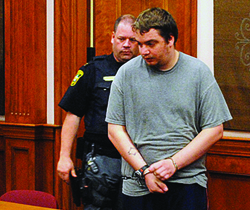
NEWPORT — Donelle Morin, a resident of West Charleston, identified Deontae McNeil as one of two men who attempted a year and a half ago to rob her and, in the process shot and stabbed her. Mr. McNeil, who is 25 years old and a resident of Putnam, Connecticut, has pled innocent to charges of attempted second degree murder and aggravated assault with a weapon.
Ms. Morin’s testimony Tuesday afternoon commanded the full attention of the 11 women and three men who, including two alternates, make up the jury. She was the last prosecution witness in the trial which began Monday morning in the Orleans Criminal Division of Superior Court.
On the morning of October 14, 2010, Ms. Morin said, she was disturbed in her shower by a knock on her door. She put on a robe and answered the door, thereby meeting “two gentlemen who changed my life.”
Ms. Morin said Andrew Ladouceur, who has already pled guilty to charges in the case, was at her door asking to use her telephone. The man, she said, told her that his truck had broken down and that he wanted to call for help.
After handing him the phone, Ms. Morin said she closed her door and went to get dressed. Once clothed she looked out and saw a gray truck parked nearby on Route 5A, near her Charleston home.
She said that she also noticed an African American man, who was with the caller. The second man asked to use the bathroom, and Ms. Morin, who said she was beginning to be suspicious of the pair, refused to allow him to come into the house.
Instead she directed him to the lawn around the side of the house.
Ms. Morin said she was worried because of a rash of burglaries in the area and suspicious because the story the men told about their truck kept changing. She phoned the State Police dispatcher, but was told that no troopers were in her area.
After making that call, Ms. Morin said she photographed the two men with her cell phone. That upset the African American man, she said.
Ms. Morin said he asked why she had taken his picture and when she told him, he said it made him nervous.
She said that she replied that his presence made her nervous.
Ms. Morin said she had to go out to an appointment and didn’t want to leave the men in the vicinity of her empty home. She said she offered to give them a ride to the truck and help them jump start their car.
Ms. Morin said she got into the driver’s seat of one of her two cars, an Audi, while Mr. Ladouceur seated himself in the front and the African American man got into the back on the driver’s side.
Before she was able to start the car she said she felt a gun at the back of her head and heard the man in the back seat say, “you’re dead meat.” Ms. Morin said she was ordered to take the men into her house.
As she raised her hands, Ms. Morin said she threw her keys away. At the same time she grabbed hold of the gun and tried to keep it pointed at Mr. Ladouceur.
Ms. Morin said Mr. Ladouceur seemed terrified by the gun pointing his direction. The man in the back seat fired two rounds from what police described as a nine-shot .22 caliber revolver.
Neither of them hit anybody, Ms. Morin said. She said the man in the back seat told Mr. Ladouceur to “get your knife out and cut the bitch.”
Ms. Morin said Mr. Ladouceur stabbed her arms and slashed her hand in an attempt to keep her away from the gun. In the meantime, the man in the back seat fired four more shots, hitting Ms. Morin in the leg and foot with two of them.
Finally Ms. Morin stopped struggling and the men dragged her from the car. They took her purse and started going through, taking her money and her cell phone, which they smashed.
While their attention was occupied, Ms. Morin said she ran to her other car, a BMW, and climbed in thinking that its keys were inside. She was mistaken and the African American man shot out the window, spraying Ms. Morin with broken glass.
The two men grabbed Ms. Morin and dragged her toward her house. They stopped when some traffic passed and Ms. Morin broke free and ran down her drive toward Route 5A. She said Mr. Ladouceur tackled her, punched her in the face and, with a knife to her neck, dragged her toward the house again.
When another burst of traffic caused the men to stop their efforts, Ms. Morin broke free again and ran toward the road. The African American man shot at her, hitting her twice in the arm, Ms. Morin said. This time she reached safety and flagged down a passing truck.
She said the men ran into her house, and while motorists were trying to help her she said she spotted two people climb into the gray truck.
“I wanted to give chase,” Ms. Morin said. But she was persuaded by her rescuers to lie down and be taken to the hospital.
The 26-year-old Mr. Ladouceur of Charleston, pled guilty to a single charge of attempted burglary of an occupied dwelling in April. That charge was reduced from those of aggravated assault, first-degree unlawful restraint with risk of injury, and attempted assault and robbery with a weapon, to which Mr. Ladouceur pled guilty in 2010.
The lower charge and the four-to-ten-year sentence that accompanied it were offered by Orleans County State’s Attorney in exchange for Mr. Ladouceur’s testimony in Mr. McNeil’s case.
Mr. Ladouceur preceded Ms. Morin to the stand. He said that he had spent a lot of time in Putnam, Connecticut, where he had run up a tab with a drug dealer he knew as D-Rock.
He said he returned to Vermont to raise money, where he was told by a friend, Jamie Chateauneuf, that Ms. Morin had 300 pounds of marijuana in his basement.
Mr. Ladouceur said he called D-Rock who wanted to take part in the robbery. Mr. Ladouceur said he borrowed a truck from John Willey and drove to Connecticut where he picked up D-Rock.
After a detour to Providence, Rhode Island, Mr. Ladouceur said he returned to Vermont, borrowed some guns on the pretext of going rabbit hunting from Arthur Blouin, and with Ms. Chateauneuf went to Ms. Morin’s house with the idea of burglarizing it.
Mr. Ladouceur said he acted only on the orders of D-Rock, and claimed to have let Ms. Morin escape in order to save her life. He acknowledged punching Ms. Morin, but said he did so “instinctively” when he thought Ms. Morin was going to hit him.
At the end of his testimony, Mr. Ladouceur said that D-Rock was Mr. McNeil.
In his cross-examination, Mr. Katims treated that claim with scorn. He mocked Mr. Ladouceur as being the “hero” of the story, and tried to get him to admit tailoring his testimony to gain a favorable outcome of his own case.
Mr. Ladouceur resisted that charge, but admitted going into Ms. Morin’s house and into her basement after she escaped.
Ms. Morin said she missed $500 that she had set aside to pay taxes when she got home. There was no testimony that claimed marijuana was found in Ms. Morin’s house.
Mr. Katims was much gentler in his cross examination of Ms. Morin, who he acknowledged in his opening statement had been robbed, stabbed and shot by a white man and an African American. He instead focused on eliciting testimony that contradicted Mr. Ladouceur’s claims of helping Ms. Morin.
In that he was only partly successful. Ms. Morin testified that Mr. Ladouceur punched her more than once, and attributed her escape solely to her own efforts. She did say that Mr. Ladouceur seemed to act in response to the African American man’s orders.
Mr. Katims’ strategy in the case, so far, has been to challenge the identification of Mr. McNeil as the African American man who shot Ms. Morin. Judge Robert Bent, who is presiding over the trial, has already refused to suppress Ms. Morin’s identification, which Mr. Katims challenged on the grounds that an initial photographic lineup was improperly conducted by State Police Detective Sergeant Darren Annis.
Sergeant Annis testified on Monday and Tuesday as to his conduct of the investigation and admitted making several major errors in the case. They included mislaying evidence and failing to ask witnesses for a detailed physical description of the African American man they saw.
Sergeant Annis testified that two people who had an opportunity to see the African American man for an extended period of time, including Ms. Chateauneuf and Mr. Blouin, failed to pick him out of a photographic lineup.
Mr. Katims is expected to call a psychologist who has conducted research on the problems of eyewitness identification to the stand on Wednesday. He told Judge Bent he hopes the case can go to the jury in the early afternoon.