Young composers get a chance to hear their works

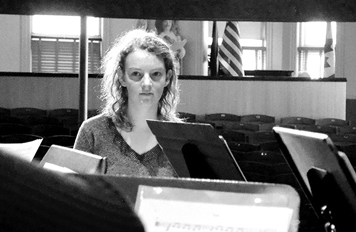
North Country music teacher Anne Hamilton and Adele Woodmansee listen as musicians from the Burlington Ensemble, including violinists Michael Dabrowski and Sofia Hirsch, rehearse Ms. Woodmansee’s String Quartet in D Minor.  Photo by Joseph Gresser

North Country music teacher Anne Hamilton and Adele Woodmansee listen as musicians from the Burlington Ensemble, including violinists Michael Dabrowski and Sofia Hirsch, rehearse Ms. Woodmansee’s String Quartet in D Minor. Photo by Joseph Gresser

copyright the chronicle 05-08-13

by Joseph Gresser

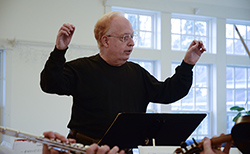
DERBY LINE — At noon on a fine spring Wednesday, a stream of youngsters from elementary to high school age poured into the doors of the Haskell Opera House.  In front of the entrance to the Haskell Free Library a man sat gazing intently at sheets of paper in his lap as he conducted an invisible orchestra.

That man, Eric Nielsen, is a distinguished Vermont composer and one of many who work behind the scenes as part of Music-Comp.  That organization, once known as the Vermont Midi Project, encourages students in their efforts to compose music by having professionals mentor them through the Internet.

On May 1, preparations were nearing completion for the twenty-sixth in a series of concerts which allow student composers to hear their works performed by professional musicians.

Among the 26 composers whose pieces were to be featured on the evening’s bill were three from North Country Union High School — Adele Woodmansee, Erin Spoerl and Bradley Dopp.  Their teacher, Anne Hamilton, has been involved with Music-Comp since it began in 1995, and has heard many of her students’ compositions played over that time.

She guided her students through the rehearsal process, sitting with Adele Woodmansee on the stage of the Haskell as four players from the Burlington Ensemble ran through her String Quartet in D Minor.

First violinist Michael Dabrowski asked Ms. Hamilton, “Is our goal to learn the piece?”

“The goal is to have a conversation with the composer,” Ms. Hamilton replied.

Her response reflected an attitude of respect that permeates the program.

The musicians immediately got it, and began asking Ms. Woodmansee technical questions about how she thought the piece should be performed.

Ms. Woodmansee, herself an accomplished violinist, answered easily in a manner that revealed that she had given the questions a great deal of thought during the compositional process.

That she did so is in part due to the work of Mr. Nielsen and his fellow composer mentors, who look over compositions e-mailed to them by the young composers and make suggestions for ways the pieces might be developed.

The exchanges often grow lengthy as compositions change and new possibilities open up.

One astounding aspect of the concerts is that young composers are afforded instrumental possibilities that a professional would envy.  For the Opus 26 performance, composers had a string quartet plus a contra bass at their beck and call, as well as the forces of the Vermont Contemporary Music Ensemble, a wind consort that includes flute, oboe or English horn, bassoon and clarinet.

Mr. Dopp’s composition Frosk, a Norwegian word meaning frog, he explained, brought together bass clarinet, contra bass and bassoon.

He, the musicians, Ms. Hamilton and some classmates squeezed themselves into a tiny dressing room for his rehearsal.

Bassist Evan Premo mentioned in an offhand way that Mr. Dopp had marked the tempo for his piece in a way that was difficult for the musicians to understand.  He took a moment to explain the math needed to figure how fast Mr. Dopp wished the piece to be performed, and made a suggestion about how to handle the matter in the future.

Clarinet player Steve Klimowski asked Mr. Dopp how he wanted a very quiet entrance performed.

The trio performed Mr. Dopp’s piece once and Mr. Klimowski made a major error, finishing long after the other two musicians.  A second attempt corrected that mistake.

Afterward, Mr. Klimowski explained to a curious onlooker that, although musicians receive the pieces well in advance of the concert, it is hard to know how an ensemble will sound without playing together.  He said there is time to work through any technical challenges an individual player might face, but only about ten minutes to play each work together.

The musicians worked through the afternoon until all trooped off to the Universalist Church for dinner.

As part of its Opus 25 concert, Music-Comp produced an e-book reviewing the organization’s history.  Executive Director Sandi MacLeod said the book will be available on the organization’s website in the middle of May.

Ms. MacLeod said the book was part of a fund-raising effort.  Grants that were available in the program’s early days are drying up, she said, and the organization is seeking new revenues.

One way they are going about it is by expanding Music-Comp’s horizons.  Ms. MacLeod said the organization changed its name in part because midi is old technology and in part because it is now a national organization working with students in many other states, including New York, Indiana and California.

Among those testifying to the effect the organization has had on them are a number of students from Orleans County, many of whom are now pursuing music as a career in one way or another.

Twins Matt and Adam Podd graduated from North Country and are living in New York City working as freelance pianists, arrangers and composers.  Matt Podd still maintains his connection with Music-Comp and works as a composer mentor.

Sam Schiavone of Greensboro, whose work was performed in four Opus concerts, is a graduate student in mathematics at the University of Vermont.  Another Greensboro participant, Mavis McNeil studies music at Skidmore College.

When students returned to the auditorium, and the audience filtered in, there was a moment not usually seen in the concert hall as composers, musicians and teachers crowded the stage for a group photo.  The performance began with a work by Susie Francy, a ninth grader from Leland and Gray High School.

Ms. Francy, who was the first from her school to have a work chosen for performance, was accompanied by her parents and her music teacher, Ronald Kelley.  She stood when her piece, called Child, was introduced and again at the conclusion stood for the applause.

Two composers, Ivan Voinov and Ms. Spoerl took turns introducing the pieces and reading statements from the artists. Ms. Francy said her composition, written for flute, oboe, cello, bassoon and clarinet, was a depiction of a child’s growth to adolescence.

Ms. Francy received a good round of applause, and the concert continued with pieces by younger composers, all of which belied their years.  It was only when a young composer stood to be recognized and was little taller than when seated, that his or her youth was apparent.

The younger composers took up the first part of the concert.  After an intermission the program was to continue with works by older students.

Instead, Ms. MacLeod stood and announced that the musicians were not satisfied with the performance they had given of Ms. Francy’s piece.

The five players returned to their places and performed the work again as a gesture of simple respect.

contact Joseph Gresser at joseph@bartonchronicle.com

Share

Warebrook Music Festival returns with a flourish

by Joseph Gresser
copyright the Chronicle July 23, 2008
DERBY LINE — The Warebrook Contemporary Music Festival wrapped up a weekend of performances Saturday night, July 12, with a concert at the Haskell Opera House.  In addition to the superb performances of contemporary music that are the series’ hallmark, director Sara Doncaster introduced a new wrinkle to the fifteenth edition of the festival — young local musicians performing on the same bill as older, professional players.
One of the youthful performers, Owen Tatum of Derby, also had “Water,” a woodwind quartet he composed, given its world premiere by a mixed group of students and professionals.
Mr. Tatum, who will be a junior at North Country Union High School in the fall, played oboe for the performance.  He was joined by Steven Tatum, his brother, who played bassoon, and two professional musicians, flutist Sarah Brady and Mark Margolies, who played clarinet.
With this addition to the festival’s mix, Ms. Doncaster is twining together two strands of her professional life.  She is not only an increasingly successful composer, but is also an elementary school music teacher who works in the Newport Center, Holland and Lowell schools.
This year Ms. Doncaster gathered six young performers, all of whom are from Orleans County.  Some of the group she already knew, either as their school music teacher or from giving them piano lessons.
Emily Wiggett of Barton performed in two programs on different instruments.  She accompanied alto Colleen Brewer of Newport Center, who sang songs by Aaron Copeland
and Samuel Barber as part of a vocal recital on Saturday afternoon, July 12.
Ms. Wiggett also played flute in a performance of “Rigaudon,” Op.60 by Arthur Foote, that evening.  She performed “Rigaudon” with two other Barton residents, Gabrielle Marcotte, who played violin, and pianist Stephanie Marcotte.
Ms. Brewer studied with Ms. Doncaster when she was in sixth grade.  She graduated from North Country Union High School in June and will study music education at Plymouth State College in the fall.
All members of the trio are current or former Lake Region Union High School students.  Stephanie Marcotte who, like Ms. Wiggett, studied piano with Ms. Doncaster, now studies nursing at Franciscan University, where she plays in the school orchestra.
At a reception that marked the close of the festival, Ms. Wiggett said she has been studying flute since the fourth grade, seven years.  As she enters her junior year at Lake Region Ms. Wiggett is looking forward to studying music at the college level.
She does not lack immediate musical challenges, as she has been accepted as a member of the Vermont Youth Orchestra.  Last year she played with the Vermont Youth Philharmonia.
Ms. Wiggett, when asked about the similarity between her background and that of Ms. Doncaster, beamed.  “It’s pretty cool.  She’s so smart and she knows how to get it across.  I plan to get it across,” she said.
Ms. Doncaster hopes that the young players who take part in the Warebrook festival do go farther in their musical endeavors.  She said she hopes that next year’s festival will include a week of workshops, that will allow students to work more closely with professionals.
In speaking of the difficulties of programming a contemporary festival Ms. Doncaster said she chose the Arthur Foote piece to fit the level of the three young players.
Of all the pieces on the festival’s concluding program, Saturday evening at the Haskell Opera House, it was the most traditional sounding.  Mr. Foote composed the trio in 1921 and it has a style reminiscent of Edwardian composers such as Sir Arthur Sullivan.
In a conversation Monday, July 13, Ms. Doncaster chose to compare it with New England composers Edward MacDowell and Amy Beach.  Ms. Doncaster said she likes to acknowledge them, particularly as all three are associated with Boston, the city where Ms. Doncaster received much of her training.
She said she hopes that the workshops will help prepare the young musicians to play some of the more challenging workshops.  One of the sessions Ms. Doncaster plans is one on extended instrumental techniques.
Ms. Doncaster had a ready explanation for the inclusion of the oldest work on the program of contemporary music, “Sonata No. 2 for Violin and Piano” by Charles Ives.  Noting that festival’s opening concert was held in the Irasburg Town Hall, Ms. Doncaster asked, “Who else would you perform in a beautiful turn-of-the-century hall with a slightly out-of-tune piano?”
At the Haskell Saturday night, the program began with a nod to Elliott Carter, the renowned American composer, who this year celebrates his hundredth birthday.  Although Mr. Carter’s music is notoriously complex and difficult, the piece selected by Ms. Doncaster, “Pastorale,” was composed early in the composer’s career when he was still under the influence of Aaron Copland’s American style.
In the melodic lines and the harmonic structure of the piano and clarinet duet, echoes of Copland could be heard.  It was a touching reminder of the beginnings of Mr. Carter’s long and adventurous artistic journey.
One of the pleasures of the Warebrook festival is a sight all too rare in most concert halls, a living composer standing to acknowledge well-deserved applause.
Both Ms. Doncaster and William Pfaff were present Saturday night to hear fine readings of their compositions.  Mr. Pfaff’s was a string quartet, “In the Abode of Soundless Poetry,” composed last year.
Mr. Pfaff’s composition was a densely textured work, neither atonal nor melodic.  The rhythmic complexities were such that even the excellent players of Warebrook, could not master them in the three rehearsals that preceded the performance.
Fortunately conductor Paul Brust was on hand to direct entrances, leaving the musicians to concentrate on the ensemble blend.  Mr. Pfaff’s work was a perfect example of the underlying principal of Ms. Doncaster’s curatorial vision — a prejudice in favor of beauty.
Ms. Doncaster’s offering, which concluded the festival, was a setting of six poems by James Joyce entitled “At That Hour.”  Tenor Jon Garrison was accompanied by an ensemble that included Ms. Brady and Mr. Margolies, along with Benda van der Merwe on violin, Darry Dolezal on cello, Mika Tanaka on piano and Aaron Trant on percussion.  Mr. Brust conducted.
This ensemble was skillfully deployed by Ms. Doncaster, who varied the instrumental texture to match each poem’s text.  The active verbs, gnash, lash, pluck and devour, that form the frame of “A Memory of the Players in a Mirror at Midnight,” were matched by Mr. Trant, who moved from the vibraphone to a modified drum kit for the song.
In “Sleep Now, O Sleep Now,” Ms. Brady bent notes on her flute in a manner that reminded one of cattle lowing.  The final song in the set, “At That Hour,” ended with a repeated six-note phrase played on the vibraphone.  The time between the fifth and sixth note lengthened with each repetition, with the final phrase left suspended, and incomplete.
Several of the players remarked after the concert that the piece marked a major step for Ms. Doncaster, a judgment which the composer said she shared.
This year’s festival was the first since 2005, but lovers of well-played contemporary music need not fear.  When she was asked if there will be another Warebrook festival next year, Ms. Doncaster immediately exclaimed, “Yes!”

contact Joseph Gresser at joseph@bartonchronicle.com

Share