Legislators tour through Jay and Newport

Featured

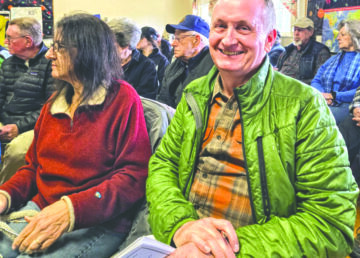
Bill Stenger, president of Jay Peak Resort, testifies before the combined forces of the House Commerce and Economic Development Committee and the Transportation Committee Tuesday at North Country Career Center in Newport.  Photo by Joseph Gresser

Bill Stenger, president of Jay Peak Resort, testifies before the combined forces of the House Commerce and Economic Development Committee and the Transportation Committee Tuesday at North Country Career Center in Newport. Photo by Joseph Gresser

by Joseph Gresser

copyright the Chronicle 2-6-13

NEWPORT — A passel of state representatives on a bus tour of the Northeast Kingdom heard firsthand about the issues that will have to be addressed to help the area adjust to $500-million-worth of planned development.  One problem the area won’t have to address is an influx of 10,000 new jobs.

Bill Stenger, co-owner of Jay Peak Resort and one of the main forces behind the new investment, told the legislators that although there will be 10,000 jobs created in response to the investment, the total of direct jobs in Orleans County will be between 1,500 and 2,000.

The rest of the 10,000 figure will be a consequence of the economic activity created by the new business, and will ripple through the state and out into New England, Mr. Stenger explained.

He was the first witness to testify before a combined meeting of the House Commerce and Economic Development Committee and the Transportation Committee, supplemented by one or two members of the House Education Committee.

The legislators arrived for lunch at the North Country Career Center after taking a tour of Jay Peak and hearing the plans for economic development in the Northeast Kingdom proposed by Mr. Stenger and his partners.  They were accompanied on their journey by a group of high-ranking officials from the state agencies of Commerce and Community Development, and Transportation.

When they got to the Career Center the delegation found a crowd of around 90 people, including educators, local officials, business owners and interested citizens had already assembled.

Representative Bill Botzow of Pownal, chairman of the commerce committee, opened the meeting and gave Representative Mike Marcotte of Coventry, his vice-chairman, an opportunity to say a few words.

“I want to thank the legislators for coming up here.  We’re really proud of what we have here,” Representative Marcotte said.

He said of the work that must be done in connection with planned development, “they’re great challenges to have, but they’re challenges we have to meet.”

Mr. Stenger, who was the first witness, told the representatives that it was the “quality and character of the community” that inspired his plans.  Capital, he said, was the key to development, and the federal EB-5 visa program, which allows foreigners to get residency status in the U.S. in exchange for a job-creating investment, has provided an ideal source of capital.

He said the program has allowed Jay Peak to realize good ideas without the necessity of having a mortgage.

When the program got to the point where it needed to be renewed by Congress, Mr. Stenger said, he sat down with Senator Patrick Leahy, who was one of those behind the law, and Governor Peter Shumlin to think of what might be done if the law was extended.

They decided that it would make sense to bring in good new businesses and give them the opportunity to grow in the Northeast Kingdom.

When the bill reauthorizing the program was signed in September it opened a three-year window, Mr. Stenger said.

In those three years two new business, AnC Bio and Menck Windows, will have to be up and running.  Other ideas, such as a hotel and convention center in Newport and a redeveloped block in the city, will have to be substantially complete, he said.

He said that he and his partners have been working closely with educators around the area to make sure that people have the skills needed when it comes time to hire workers.

The issues that will need to be addressed as the current plans come to fruition include transportation, health care, housing, and education and training.

“All those elements are represented in this room,” Mr. Stenger said of those seated behind him.

“Keep our eye on us, because it’s been a long time since this part of Vermont has been a leader.  We’re going to do great work,” he concluded.

Before leaving the witness table Mr. Stenger, smiling broadly, said he was glad that whoever put together a list of projects for the Agency of Transportation included rebuilding Route 242, the road that serves Jay Peak.  “It made my day.”

Mr. Stenger was followed by superintendents Robert Kern of the North Country Supervisory Union, Chris Masson of the Essex North Supervisory Union, and Stephen Urgenson of the Orleans Central Supervisory Union.

Mr. Kern said that many of the schools in the area are old and need work if they are to accommodate an increased population of students.  He asked the legislators to consider providing help for school renovation, noting that Morgan has repeatedly voted down bonds because its voters feel they cannot pay for renovations on their own.

He also suggested that the state needs to provide demographic information to allow schools to make informed decisions about needs they will have to meet quickly.

Mr. Kern said he has no way of knowing how many new workers will be arriving or how many children they will bring with them.

Mr. Masson pleaded for consideration of spreading the development into the Canaan area.  The number of jobs in the community has dropped precipitously since Ethan Allen moved much of its production to its Orleans plant, he said.

Mr. Urgenson asked for a better communications infrastructure in the Northeast Kingdom.  Faster communications and better cell phone coverage will result in greater creativity, he argued.

Representing higher education, Penne Ciaraldi of Community College of Vermont, Ann Nygard of Lyndon State College, and Cindy Robillard of the Department of Labor outlined their efforts to create a partnership to develop job training programs in the Northeast Kingdom.

Ms. Nygard said educators have to build a “cradle to career pathway” for students.

Eileen Illuzzi, interim director of the Career Center, told how her school has worked to anticipate career opportunities.  She said the career center established its hospitality program three years earlier after a visit to Jay Peak.

“Hospitality is not a career choice, we need to make it a destination career,” she said.

She said the career center is “all about options.”  Even students who decide not to complete a two-year career program may have gained something.

Ms. Illuzzi told the story of a student who hoped to go to medical school.  When she fainted at the sight of blood during a visit to an operating room, it gave her a chance to reconsider her path, Ms. Illuzzi said.

The Menck Window company, a German firm, may want to consider working with the career center to create an apprenticeship program, Ms. Illuzzi said, something that accords with their national style.

Patricia Sears of the Newport City Renaissance Corporation gave a ringing endorsement of the city.

“This is Newport’s time, this is Vermont’s time, this is our time,” she declared.

She talked about opportunities that can be created by a planned foreign trade zone, which if approved by the federal government would greatly expand the possibilities of international trade in the area.

“We’re all on the path to awesome,” Ms. Sears announced.

Doug Morton of the Northeastern Vermont Development Association said his organization has conducted a number of studies of transportation needs in Orleans and Caledonia counties.  The studies could use revision, he acknowledged, but the basic information is still sound.

After the scheduled testimony, Mr. Botzow asked if any individuals wished to offer their opinions.  Nick Ecker-Racz of Glover stepped forward to tell the legislators that he thinks that an improved public transportation system ought to be part of their thinking.  He also warned against programs that involved excess regulation.

Finally Mr. Ecker-Racz cautioned the representatives that increased wealth in the community will inevitably result in an influx of drugs, including cocaine and heroin.  Programs should be put in place beginning in elementary school to guard against the problem.

Eleanor Leger of Charleston said she thinks that good local businesses will thrive in the new environment.  She expressed excitement about the proposed free trade zone, which she said could aid her business, Eden Ice Cider, which gets many of its bottling supplies from South America.

Reed Ogden of Barton warned against too eager acceptance of a Walmart scheduled for construction in Derby.  Studies, he said, show that every Walmart employee costs taxpayers $1,000 in support services due to the company’s low wages and benefits.  He acknowledged that the data behind that study was eight years old.

Mr. Ogden pointed to a community-sponsored for-profit store established in Saranac Lake, New York, as an example of an alternative way for people to buy the goods they need at a price they can afford.

Finally, Newport Mayor Paul Monette told the legislators that his city welcomes all the development.  He said that transportation was the only problem he could see.

He said that a bottleneck at the bottom of Main Street could be eliminated by building a roundabout.  Or a new bridge, which he suggested might have to go through the spot where Representative Marcotte’s store now stands, could serve as a bypass for traffic.

In concluding the meeting Mr. Botzow offered a kind of benediction.

“I think the future is bright,” he said.  “I hope in five, ten or 20 years we look back and say ‘we did it right.’”

contact Joseph Gresser at joseph@bartonchronicle.com

For more free articles from the Chronicle like this one, see our Editor’s Picks pages. For all the Chronicle’s stories, pick up a print copy or subscribe, either for print or digital editions.

Share

In Glover: Fire destroys 123-year-old house

Featured

Photo by Adam Heuslein

Photo by Adam Heuslein

by Tena Starr

copyright the Chronicle 1-30-2013

GLOVER — State Police investigators say the fire that destroyed the 123-year-old house at Green Mountain Fence here early Saturday morning was not suspicious, but what started it remains a mystery.

“They have no idea,” said owner Doug Conley, who lives in Glover a few miles from the mill.  He said he got a call shortly after 4 a.m. saying the house was on fire.

“When you get a call like that the first thing you think is maybe it isn’t that bad.”  But he said he could tell when he looked out the window that it was.  “The sky was already orange,” he said.  “When I got there a third of the roof had a hole through it.”

The mill itself did not burn, and Mr. Conley said the fire department went through heroic efforts to save his logging truck, which was parked near the house.

“I can’t say enough about these guys who fight these fires,” he said.  “It was ten below zero.  My log truck, they stayed on that truck for about an hour, and it’s still intact.  There’s no way I’d put my life on the line for a log truck.”

Power lines had fallen and electricity was dancing over the roof, Mr. Conley said.  “It was a bad scene.  Those guys did a great job.  By the time they got there that thing was already so hot.  I’m just thankful no one got hurt.”

Mr. Conley and his sister Donna Perron bought the sawmill at a foreclosure auction in October.  Howard Conley, their father, started the mill in 1946.  He operated it for about 50 years before retiring in the mid-1990s.  The business has only briefly been out of Conley family hands.  The house itself predates the mill.  It was built in 1890.

The house had been renovated and Mr. Conley had three tenants lined up.  Donna Daniels had planned to move into one of the apartments on Saturday morning, the day of the fire.  Her belongings were already packed into a U-Haul and ready to go.

Another prospective tenant is a teacher at Barton Graded School who lives in Walden and had hoped to move closer to her workplace in February, Ms. Perron said.

The third was Amanda Aiken, who had already moved much of the inventory for her candle business, Strictly Vermont Candle, into the office part of the building, Mr. Conley said.  That included wax and scent, he said.  “She must have had 50 or 60 buckets of oil scent.  You could tell when that caught fire.  It was hot.”

Ms. Perron claims responsibility for the fact that she talked her brother into buying the business last fall.

“I kept saying, god, I just don’t want it to not be in the family.  I went there a couple of days before the auction and looked at the foreclosure sign thinking do we keep it or let it go?  I called Doug and said I want to buy it.  That’s how we got the mill back, an impulse, a sentimental thing.”

Glover Fire Chief Allen Mathews said the call came in at 4:14 a.m.  By the time firemen arrived at the house on Route 16, flames were already coming through the old, gable end, he said.

“What caused it I don’t know,” Mr. Mathews said.  “I don’t think anybody will ever know.”  He said it looked to him like the fire had started up high in the old section of the building rather than the newer office area.

Fires are not uncommon in frigid weather when wood stoves can run too hot.  But in this case, no one was living in the building, and the heat was set at 58 degrees, Mr. Conley said.  “It was all baseboard hot water, not wood.”

The house was old, and the fire was hot, Mr. Mathews said.  Glover, Barton, Orleans and Irasburg fire departments responded and worked well into Saturday morning.  Mr. Matthews said he does not know who called in the fire.

He said he would have been less surprised if the mill had burned rather than the house.  It was a shock, he said.

It was a rough night to fight a fire with temperatures well below zero.  A couple of trucks froze up but were able to stay in service, Mr. Mathews said.

“The biggest thing is to try to keep the water supply.  Once the water stops, things start getting hairy.”  Also, there were power lines down in the road “which didn’t help us out any,” he said.

Ms. Perron said the oil and propane tanks had been filled that day to get ready for tenants moving in.

It’s not likely the house will be rebuilt, she said.  “Maybe they’ll put something really small there.  It’s too soon to know.”

“The reason I wanted to buy it was because of memories in the old house,” she said.  “I remember my dad sitting there in the office with his big cigar in the chair that used to rock backwards.  Growing up, me and my friends used to go in the office at night and pretend we were secretaries.  There was this beautiful wide stairway that led to the upstairs bedrooms, and we’d slide on it and pretend it was a horse.  We had no personal belongings there, but we had a lot of childhood memories.”

She said she posted some of her memories on Facebook and was immediately deluged with hits from other people who remembered her father, or bringing wood to the mill.

“I was born in that house,” Mr. Conley said.  “There’s a lot of fond memories.  There’s no replacing that.”

He said that when he was working on the house recently he found some of the wood in the building stamped C.P. Bean.  “I believe they had the first sawmill in town, he said.

The entire house, even the attic, had been rewired in the past five or six years, Mr. Conley said.  “It kind of makes you wonder what to hell went wrong.  Like the fire marshal said, rats, mice, squirrels….  The office part was a brand new building.”

Detective Sergeant David Sutton of the State Police Fire Investigation Unit and an investigator from the Vermont Division of Fire Safety investigated the fire, which they ruled unsuspicious.  However, anyone with information is asked to call Detective Sergeant Sutton at (802) 773-9101.

contact Tena Starr at tena@bartonchronicle.com

Share

In Greensboro: Hill Farmstead Brewery expansion wins approval

Featured

Hill Farmstead Brewery in Greensboro.  Photos by Bethany M. Dunbar

Hill Farmstead Brewery in Greensboro. Photos by Bethany M. Dunbar

by Bethany M. Dunbar

copyright the Chronicle 1-23-2013

GREENSBORO — Hill Farmstead Brewery was approved for a planning and zoning conditional use permit after a hearing on Wednesday, January 16.

The application is to add some room for storage, to bring equipment and supplies that are currently outside or stored in Hardwick under a roof at the brewery, and to open a separate retail area.  Currently there is a small bar and retail area in part of the brewery — essentially a garage.

The hearing was run by Zoning Board Chairman Jane Woodruff, who asked brewery owner Shaun Hill to present some background and outline his plans.

Inside the brewery is a small retail area where people can buy small tastes of beer, fill up growlers, and buy glasses and T-shirts and some bottled varieties.  Photo by Bethany M. Dunbar

Inside the brewery is a small retail area where people can buy small tastes of beer, fill up growlers, and buy glasses and T-shirts and some bottled varieties. Photo by Bethany M. Dunbar

Mr. Hill plans to add on to the existing brewery in two phases, probably over two years.

Hill Farmstead Brewery has been in business for three years and has attracted attention from beer lovers all around the country and internationally.  It is rated as one of the top five microbreweries in the world by a website called Rate Beer.

The room was packed with people at Wednesday’s hearing, almost all of whom had come to support the application.

One set of neighbors said they did not like the traffic on the back road where the brewery is situated, and wish the business did not include selling beer directly to the public.

Mary McGrath said she and her husband worked with Mr. Hill and some of the other neighbors to put conservation easements on their land and create a wildlife corridor between the Barr Hill Nature Preserve and Long Pond.  She said the brewery with retail traffic seems out of character.

“We now feel somewhat ambushed by Shaun’s proposal,” she said.  She said she likes and respects Mr. Hill, but doesn’t like the plan.

“This is not a farming nor a forest enterprise,” she said.

Clive Gray asked how many acres of the property had been conserved.  Mr. Hill said 95 acres out of 99 acres were conserved, but he kept five acres out because he had always planned to build a brewery.  He said the Vermont Land Trust has approved his expansion plan.

He told the members of the zoning board and planning commission he wanted to start a brewery as a way to make a life and a business for himself in the town where he grew up.  He is the eighth generation of Hills to live on his farm.

“I had a sense of place.  I knew I wanted to spend my life in Greensboro,” he said.  He added that the retail side of the business is critical to be able to make a living and employ people.  He employs three people, and expects to add one more.

Phil Young deals with cold beer apparatus as the kegs were stored outside.  In the background is Dan Surarez. Photo by Bethany M. Dunbar

Phil Young deals with cold beer apparatus as the kegs were stored outside. In the background is Dan Surarez. Photo by Bethany M. Dunbar

“Right now all of our glass and all of our kegs are kept outside in the snow and in the rain,” he said.

He said a better retail space, storage, and packing area will make the whole process more efficient.  He and his staff currently make about 60,000 gallons of beer a year, and 100,000 gallons a year would be a comfortable number.  His plans are not to grow a lot more than that.

“I’m not interested in running 30 or 40 or 50 employees.  It’s not within the scope of what I’m trying to do,” he said.  “I live where all of this is going on.”

He said the brewery is right beside his house and sometimes people wander into the house looking for a bathroom.

He added that there are a couple of reasons the traffic might ease up.  One is that there are lots of new breweries opening, all around the country and locally.  He is also hoping to get a change in Vermont law that would allow him to mail beer directly to customers.  Currently wine makers can mail wine, but beer makers cannot mail beer to out-of-state customers.

“We’re not purposely trying to bring people to us,” he said.  He said he doesn’t advertise and the retail side of the business is only open from noon to 5 p.m., Wednesdays through Saturdays.  The brewery is also starting to sell limited numbers of tickets to three special events each year to keep numbers under control.

He wondered how people would feel if Rocking Rock in Greensboro became known as an important geological formation and people started driving into town to see it by the droves.  If that happened, would local people be upset with the town government, upset with the rock, or would they develop a special appreciation for it themselves?

Most in the room supported the project and said the brewery has helped the town.

“Right now I’m in my slow period,” said Rob Hurst of the Willey’s Store.  He said this time of year he suffers when he loses one regular customer, which happened recently when someone had to go into a nursing home.

He said it’s clear that Hill Farmstead Brewery and the Jasper Hill Farm and cheese making business are drawing new business to Greensboro.  People come to town to try to find those two places, he said.

“They’re always stopping and asking for directions,” Mr. Hurst said.

To try to help people — and to draw some of their business — he has put a map up beside his gas tank showing people how to find Hill Farmstead and Jasper Hill.  He hopes that the tourists will fill up.

Rod Kerr, a neighbor of Mr. Hill’s who has a second home he rents out to tourists, said people who want to go to the brewery have been giving him lots of business.  Some were renting the place that night.

“The amount of money that trickles out of that brewery is unbelievable,” he said.  “We have no problems with it.  It’s tremendous.  Let’s put Greensboro on the map instead of trying to hide it.”

Mateo Kehler, one of the owners of Jasper Hill Farm, said Shaun Hill is to be congratulated.  He said he doesn’t know of many people who start from scratch that makes a mark on the wider world the way his has done.

He said these kinds of businesses are creating excitement among a new generation of business people in Greensboro.  It will encourage younger people to move here instead of leaving, he said.

“At the end of the day, you can take the pulse of the community in the school yard, and I think we’re doing okay,” Mr. Kehler said.

At right is Bob Montgomery, getting ready to pull down the overhead door.  At left is Phil Young.  Photo by Bethany M. Dunbar

At right is Bob Montgomery, getting ready to pull down the overhead door. At left is Phil Young. Photo by Bethany M. Dunbar

Jackie Tolman, another neighbor, said she has children and animals, and Mr. Hill always lets her know if there is an event coming up.  He has spoken to her often about the traffic situation to ask if it’s bothering her.

“Shaun is a most conscientious neighbor and an excellent communicator,” she said.  “I have complete faith that his vision is what he says it is.”

Mr. Hill was asked by the planning commission and zoning board members if he had done any traffic studies.

It has doubled very year, he said.  “We could never make enough beer to satisfy demand.”  He said 95 percent of the beer is sold within 60 miles of the brewery.

Asked about landscaping plans, Mr. Hill said he is working with the Elmore Roots nursery and intends to plant apple trees and fruit plants, including some of what might have been Lewis Hill’s original cultivars, to use in the beer making process.

Asked about energy plans, Mr. Hill said he currently has a permit to spread some of the waste from the beermaking process on the fields.  Some day, he said, he would like to work with Peter Gebbie, who has a methane digester.  He is also interested in adding wind or solar power at some point.

At this point the brewery has 16 parking spaces and the plans are for 36, so cars won’t have to park on the side of the road.

The permit was approved with conditions.  No signs will be larger than six feet square or lit internally, and they will comply with all setback requirements.  If the present sign by the side of the road is moved, it should comply with setback requirements and be moved back to 50 feet from the center of the road.

contact Bethany M. Dunbar at bethany@bartonchronicle.com

For more free articles from the Chronicle like this one, see our Editor’s Picks pages. For all the Chronicle’s stories, pick up a print copy or subscribe, either for print or digital editions.


Share

In Derby: Walmart could open in 2014

Featured

walmart

Burlington-based developer Jeff Davis points to a drawing of a proposed Walmart Tuesday during a ceremony to announce the project. Many local and state officials attended to celebrate the long-sought big box store including, from left to right, state Senator John Rodgers, Lawrence Miller, secretary of the state Agency of Commerce and Community Development (nearly hidden), Derby Selectman Beula Jean Shattuck, Derby Selectman Stephen Gendreau, state Representative Loren Shaw, and Derby Selectman Brian Smith. Photo by Joseph Gresser

 by Joseph Gresser

copyright the Chronicle 1-16-2013

DERBY —  “Since Ames closed five years or so ago my vocabulary has consisted of two four-letter words — when and soon,” said Brian Smith, chairman of the Derby Selectmen, Tuesday.  “Now is a good word to use.”

He was speaking a crowd gathered in a field just off Route 5 where, if all goes smoothly, a Walmart might open its doors in the fall of 2014.

The crowd included many local residents and a sizeable array of state legislators along with Governor Peter Shumlin.

All were there to cheer the announcement that after eight years of off and on discussion, Walmart, the Arkansas-based retail giant, plans to build an almost 150,000-square-foot Supercenter in the Northeast Kingdom.

The mood was upbeat.  There were protestors on hand, but their signs were meant for the Governor and supported a wind tower moratorium.

Mr. Shumlin, though, was focused on the new store, which he said would complement other development planned for the Northeast Kingdom.

He pointed out Gisele Seymour, one of the project’s biggest supporters.  “Gisele gathered more signatures for the project than there are live people in the Kingdom,” he joked of her petition drive.

“This is how we create jobs,” Mr. Shumlin said.  He said the project “fits into a mosaic of thousands of jobs for Kingdom kids.”

Mr. Shumlin crowed that the Derby store would be a victory over New Hampshire, to which many Kingdom residents have traveled to shop for years.

“New Hampshire loses revenue.  New Hampshire loses a few jobs and we gained them.  It’s about time we got smart,” he declared.

Developer Jeff Davis built a Walmart in Williston and has begun construction, after a long battle with opponents, on one in St. Albans.  He acted as master of ceremonies.  He said that Mr. Shumlin had worked with him on the project but was not a “rubber stamp.”

He said the Governor asked questions about the size of the store and the possibility of putting it in Newport instead of on the Newport-Derby Road.  Mr. Davis said that a study conducted to determine the feasibility of a proposal to build the store in Newport floated by the Preservation Trust of Vermont (PTV), was conducted at the behest of the Governor.

The study determined that the PTV proposal to build a multi-story Walmart on Main Street in Newport was not economically sound.

Mr. Davis introduced and thanked Senator Bobby Starr for his longstanding support along with former Senator Vince Illuzzi, who missed the event.

Newport Mayor Paul Monette came in for special praise for his support of the project, as did Mr. Smith.  “He’s a household word at my house and my office.  He’s called and called and called,” Mr. Davis said.

Alexandra Serra, who is from the public relations department of Walmart’s New England office, said the new store will mean 300 more Walmart jobs in Vermont.  She said the company will also increase its charitable contributions in the state, which, she said, currently amount to $500,000 a year.

Ms. Serra confirmed reports of a new policy by Walmart to offer jobs to any veteran who left the service with an honorable discharge in the past year.

She said that the new store will definitely include a grocery department with fresh food, but otherwise said plans for what departments the new store will include have yet to be finished.

After the brief ceremony, which attracted media attention from around the state, Mr. Davis discussed some of the details of the project.

The plans for the store, displayed on both sides of the podium, Mr. Davis said are just preliminary drawings.  The actual plans will not be drawn up until Walmart has decided what it needs.

Mr. Davis said Walmart originally wanted to have a 180,000-to-190,000-square-foot store, but scaled it back at his request.

He said that Tuesday’s announcement marks only the beginning of the process.  Before the permitting process can get underway Mr. Davis said, there will need to be studies about the project’s effects on the local economy, traffic and air quality as well as storm water and sewer studies.

Once those studies are complete, he said, he will draw up plans and begin the Act 250 and Derby town planning process.  He will also start negotiating with local leaders about impact fees.

Agreements drawn up with Derby and Newport and ratified by wide margins in balloting in each town commit both communities to support Walmart in the permitting process.

They also promise to provide funds to the towns to mitigate any untoward impacts the project may have.  Newport is to get at least $600,000 over six years.  Derby’s payments will be negotiated, Mr. Davis said.

There are still potential hurdles, Mr. Davis said, including the possibility that people may try to block the store.

Mr. Davis said, “This is a developer’s risk project.”  If Walmart decides it will take too long or cost too much to build in Derby they can still back out.

Being at risk is no change for Mr. Davis.  He bought the property between Route 5 and Shattuck Hill Road for about $1-million eight years ago.  Last year he added more land to the parcel, investing another $600,000.  He still has enough property to build several smaller stores near the Walmart, although Mr. Davis said he currently has no plans for the land.

contact Joseph Gresser at joseph@bartonchronicle.com

For more free articles from the Chronicle like this one, see our Editor’s Picks pages. For all the Chronicle’s stories, pick up a print copy or subscribe, either for print or digital editions.

Share

In court: Roger Pion found incompetent to stand trial

Featured

Attorney David Sleigh (left) represents Roger Pion in Orleans Superior Court.  Photo by Joseph Gresser

Attorney David Sleigh (left) represents Roger Pion in Orleans Superior Court. Photo by Joseph Gresser

by Joseph Gresser

copyright the Chronicle 1-9-2013

NEWPORT — The trial of Roger Pion on charges related to the destruction of seven Orleans County police vehicles will not be going forward any time soon.  Mr. Pion was found incompetent to aid in his own defense Tuesday after a hearing in the Orleans Criminal Division of Superior Court.

Both Mr. Pion’s lawyer and the Orleans County State’s Attorney agreed that his mental condition will not permit a trial, and Judge Howard VanBenthuysen agreed, scheduling a hospitalization hearing.

Mr. Pion was charged with driving a farm tractor over the sheriff’s vehicles on August 2, 2012.

According to an affidavit from State Police Lieutenant Kirk Cooper, police heard on September 12 that the 34-year-old Newport resident was being “advised by the gods to start shooting people.”

The information came secondhand from an acquaintance of Mr. Pion’s, Lieutenant Cooper said.  He said the man who actually heard this from Mr. Pion was reluctant to speak to the police because he feared it would jeopardize his employment, but was getting nervous about being around Mr. Pion because he seemed to be “going off the deep end again.”

Lieutenant Cooper said he sent Trooper Debra Munson to speak with the man who first called them.  He told Trooper Munson that he also didn’t want to be involved, but that he didn’t want to feel responsible in case somebody got hurt, Lieutenant Cooper said.

The friend told police that Mr. Pion told him about hearing voices and about a plan to run over sheriff’s cruisers before the vehicles were destroyed on August 2.  His friend was worried because he knew Mr. Pion was as good as his word, Lieutenant Cooper said.

Lieutenant Cooper said he got a call on September 12 from a Newport therapist, who said she had spoken with a member of Mr. Pion’s family.  The family member told the therapist that Mr. Pion planned to do something two days later at noon, Lieutenant Cooper said.

He said the therapist heard that Mr. Pion wouldn’t say what he planned to do.  The therapist said Mr. Pion was delusional and thought he had a camera in his eye, Lieutenant Cooper said.

Lieutenant Cooper said that he called Dr. Bernard Norman shortly after hearing from the therapist and told him what he had heard.  On Thursday, September 13, Dr. Norman left a message saying that Mr. Pion had been seen by a psychiatrist who said he did not need to be hospitalized, Lieutenant Cooper said.

At the time, Judge VanBenthuysen ordered Mr. Pion to comply with required mental health treatment, but accepted the therapist’s recommendation and did not revoke his $50,000 bail.

contact Joseph Gresser at joseph@bartonchronicle.com

For more free articles from the Chronicle like this one, see our Editor’s Picks pages. For all the Chronicle’s stories, pick up a print copy or subscribe, either for print or digital editions.

Share

Reporter seeks damages for arrest on Lowell Mountain

by Paul Lefebvre

copyright the Chronicle 1-9-2013

The legal fight between Green Mountain Power (GMP)  and Chronicle publisher and reporter Chris Braithwaite has shifted from criminal to civil court.

Defense attorney Phil White filed a civil complaint late last month alleging that GMP had violated his client’s civil rights when Mr. Braithwaite was arrested on December 5, 2011, for covering a wind protest on Lowell Mountain.

Mr. White charges that GMP and its agent on the site, David Coriell, “knew or should have known that Braithwaite had permission to be on the property and that, at the very least, misinformation provided by Coriell and GMP to law enforcement had caused Braithwaite to be wrongly taken into custody, arrested, and subsequently charged with and prosecuted for unlawful trespass.”

The civil complaint comes close on the heels of a ruling handed down by Judge Howard VanBenthuysen that dismissed a criminal charge of unlawful trespass brought against Mr. Braithwaite and forbids the state to bring the charges back at a later date.

In dismissing the case with prejudice, Judge VanBenthuysen noted that he failed to see how the state could bring back the charge against the journalist in light of the e-mails among GMP officials giving the press permission to be at the site.

After noting the e-mails only came into view as the case was about to go to trial, the judge wrote:  “Consent is a key element of the offense, and GMP apparently consented to the presence of media at protests, and gave instructions that the media should not be arrested.”

In her brief to the court, Deputy State’s Attorney Sarah Baker argued against dismissing the charge with prejudice, saying the state could still make a case against Mr. Braithwaite by bringing Mr. Coriell, who has since left Vermont, back to testify.

The judge concluded, however, that was stretching the point, as it was unlikely that Mr. Coriell could give testimony that would rebut the evidence found in the e-mails.

“Under the circumstances this is the rare case in which a dismissal with prejudice is appropriate, given the late revelation of consent.”

The ruling was released on December 24 and the day after Christmas, December 26, Mr. White filed a civil complaint against GMP.  Along with the complaint, Mr. White also asked the court to revise a protective order to return to GMP documents that were sealed when the criminal case was still active.

Mr. White argued in his brief that he wanted to retain the documents on the grounds they constitute evidence in the civil suit he is pursuing against GMP.  If the court grants his request, the documents would be kept from public view until further court order.

The civil suit filed by Mr. White seeks damages on four counts:  false arrest; false and malicious prosecution; fraud, slander and false report; and fraudulent concealment.

The suit asks for compensatory damages in the amount of $22,530 (Mr. White’s fee for Mr. Braithwaite’s criminal defense) along with attorney’s fees and expenses in the civil case.  The suit further alleges that Mr. Braithwaite’s civil rights were violated, and seeks punitive damages, which are characteristically sought as a deterrent.

In his discussion of the events leading up to his client’s arrest, Mr. White says that GMP anticipated Mr. Braithwaite’s arrival at the protest and spelled out a course of action for its agent at Lowell Mountain.

GMP officials, according to the complaint, “gave Coriell explicit directions to inform law enforcement that Chris Braithwaite and any other members of the working press who showed up to cover this protest had GMP’s consent to be there to cover this event and that they were not to be arrested.”

As it turned out, Mr. Braithwaite was the only reporter present at the site, and was arrested when he refused a police order to leave.  Mr. White argues that after his client was arrested, GMP failed to step forward to explain their instructions to Mr. Coriell and reverse the arrest.

Their failure to do so, the attorney further argues, violated Mr. Braithwaite’s civil rights.  The attorney said that Mr. Braithwaite, as a journalist, had written “fierce editorials opposing GMP’s commercial wind project” on Lowell Mountain.

“At all times material to this complaint GMP and its agents, including Coriell and Orleans County law enforcement officers have jointly participated in the planning and execution of arrests of protesters,” charges the complaint.

“GMP and/or Coriell were acting under the color of law and engaging in ‘state action’ when they maliciously gave the government false and misleading information with the purpose of causing the government to engage in false arrest and wrongful prosecution.”

Green Mountain Power did not respond Tuesday to a request for comment.  Nor has the company filed a response in court to the complaint.  When the possibility of a civil law suit was raised last month, a company spokesman told a reporter that any legal claim against Mr. Coriell would be frivolous.

contact Paul Lefebvre at paul@bartonchronicle.com

For more free articles from the Chronicle like this one, see our Editor’s Picks pages. For all the Chronicle’s stories, pick up a print copy or subscribe, either for print or digital editions.

To read court documents connected to this case, please click on the links here:  No1-citation

No2-recordcheck

No3-information

No4-Sheriff’s affidavit

No5-Coriell’s affidavit

No6-Brooks affidavit

No7-Motion to Dismiss

No8-state’s response to No7

No9-Defense Memo in support of No7

No10-renewed motion to dismiss

No11-motion to dismiss with prejudice

No12-state’s opposition to No11

No13-judge’s ruling on No11

No14-civil complaint

Share

Breaking news: Charge against publisher dismissed “with prejudice”

Featured

Wind towers at Lowell Mountain, as seen from Irish Hill Road.  Photo by Bethany M. Dunbar

Wind towers at Lowell Mountain, as seen from Irish Hill Road. Photo by Bethany M. Dunbar


copyright the Chronicle 12-27-2012

Judge Howard VanBenthuysen has dismissed “with prejudice” a criminal charge of unlawful trespass against Chronicle Publisher Chris Braithwaite.
Continue reading

Share

Abenaki buy forest and farmland in Barton

Featured

by Tena Starr

copyright the Chronicle 12-19-2012

BARTON — For the first time in two centuries, an Abenaki tribe in Vermont can claim tribal forestland.  As of Monday, the roughly 1,000-member Nulhegan Abenaki own 65 acres in Barton on the May Farm Road.  Title is held by Abenaki Helping Abenaki, a nonprofit created several years ago to preserve the culture of the Nulhegan Abenaki.

The tribe, which the state of Vermont officially recognized in 2011, has been working on the purchase for more than a year.  The Vermont Land Trust holds a conservation easement on the property to make sure it remains undeveloped.

Tribe members will continue, and ultimately expand, an existing sugaring operation on the land.  It will also be used for a tribal community garden, said Luke Willard of Brownington, former tribe chief and a current trustee who was pivotal in organizing the purchase.

“All Nulhegan Abenaki land has been gone for a long, long time,” Mr. Willard said. “This is the first community-owned piece of land for the tribe in literally over 200 years.  We’ve got a lot of celebrating to do.  This is a really big thing for the leadership and the citizens of the tribe.

“It’s also a big thing for the town of Barton and surrounding communities,” Mr. Willard added.  “The way we’ve set it up the land will be conserved forever.  We’re allowing public access.  We’re not allowing motor vehicles, but foot travel, horseback riding, cross country skiing, bird watching, hiking within reason.  We’re willing to share the woods with folks.”

The land was paid for largely through fund-raising and grants.  Prior owner Eric Lanou sold the development rights to the Vermont Land Trust.

“We worked hard to raise this money,” Mr. Willard said.   “But everybody loved this project.  People wanted this to happen.”

Tribe members plan to sugar on the land this spring, gradually increasing the size of the operation as time goes on, Mr. Willard said.  They’ll do it the old-fashioned way, with buckets rather than tubing.

Eventually, the Nulhegan hope to tap as many as 3,000 or 4,000 trees and to develop their own brand of syrup — not just pure Vermont syrup, which has its own fame, but the first brand of Vermont Abenaki-made syrup.  “This is going to be the first maple syrup produced by an Abenaki tribe in centuries,” Mr. Willard  said.

The sugaring operation will be labor intensive.  “Our intention is to take folks who are unemployed or underemployed and put them to work for the season,” Mr. Willard said.  “It’s going to be done fairly old school.”

Also, he said the tribe will invite schoolchildren to come see how sugaring is done the old-fashioned way.

“And we want to have a small exhibit where folks can actually see how maple sugar was produced prior to Colonialism,” he said.  “It’s very laborious compared to contemporary sugaring.”

Money from the sugaring operation will go to support the tribe’s programs, such as Nulheganaki Youth Outreach, which does presentations about Abenaki history and culture.  When that program first started audiences were tiny, sometimes no more than a half dozen people, Mr. Willard said.  These days presentations are made to much bigger groups of 50 or more people.

“It’s grown incredibly with zero funding,” he said.  “So can you imagine what they could accomplish in that program with $4,000 or $5,000 in revenue generated from sugaring?”

The Nulhegan also operate a program called The Seventh Harvest, which is basically a community garden.

Mr. Willard said it started years ago, largely as a typical food shelf to help the needy.  “We realized we were helping people who were down and out, but we weren’t really empowering them to help themselves,” he said.

By coincidence, a Johnson State College professor took an interest in the Abenaki gardening practices, which were still being used by some.

“He was under the impression that these practices were pretty much extinct,” Mr. Willard said.  “When we realized that was the common belief, we worked with JSC and got a grant from the Lake Champlain Basin Program to study these agricultural technologies.  It became apparent to us that these ancient practices could be extinct in as little as a generation.”

The study, combined with a desire to provide healthier food, led to a community garden at Mr. Willard’s home in Brownington.

That garden will move to a clearing on the Barton land.  It could provide food for 15 or 20 families.

The rules for its use are that growers must learn traditional Abenaki growing practices, if they don’t already know them, and they must agree to pass that knowledge on to someone else in order to keep traditions alive.

The little clearing with its rich soil was one of the reasons the Barton land was so appealing, Mr. Willard said.  “I looked at it, and I saw mound gardens.”

Although the land has practical uses, it also has more symbolic ones as well.

A tribe is not an organization; it’s a body politic, just like a town, Mr. Willard said.  But the Nulhegan have not had a communal meeting place.

“There are Abenakis who own their own land,” he said.  “But we didn’t have a community place to meet like towns do.  We were always borrowing places to meet.  It’s difficult to maintain a government when you don’t have a central place.”

The tribe will use the land to hold meetings, events and celebrations.

“Part of our creation story is that the creator wanted us to be the stewards of the land,” said current chief of the Nulhegan Abenaki, Don Stevens, who takes a more spiritual view of the acquisition.  “After the land was taken from our ancestors, we were no longer able to be the stewards we were asked to be.  Our hearts are heavy with that burden.  With our own forest, we can pick up the soil, feel it, smell it, and know that our ancestors walked on this land and it is ours to protect.  For this land, we’re able to fulfill our promise.”

Gaining official recognition for the tribe, as well as others in Vermont, was a long and contentious process.  Mr. Willard said that was, at least in part, because some believed the tribes would make land claims or try to establish casinos.

Nothing could be further from the truth, he said.  The tribe paid for the Barton property, which it intends to share with everyone.  “Our intentions were always positive.”

contact Tena Starr at tena@bartonchronicle.com

For more free articles from the Chronicle like this one, see our Editor’s Picks pages. For all the Chronicle’s stories, pick up a print copy or subscribe, either for print or digital editions.

Share

Publisher’s trespassing case dismissed

Featured

The Lowell Mountain wind towers as seen from Irish Hill. Photo by Bethany M. Dunbar

by Paul Lefebvre

copyright the Chronicle 12-12-2012

NEWPORT — A utility wind developer company that tried to do the right thing by the press appears to have shot itself in the foot when it allowed the arrest of a reporter and then failed to step forward and rectify an action contrary to company policy.

The Orleans County state’s attorney’s office last week dismissed a criminal charge of unlawful trespass brought against Chris Braithwaite, a reporter for and publisher of the Chronicle in Barton.

Mr. Braithwaite, who had been spearheading his paper’s coverage of the wind project on Lowell Mountain and the controversy it triggered, went to the site on December 5, 2011, to cover a demonstration that protesters had scheduled for the morning.

Police intervened and arrested six protesters, who became known as the Lowell Six.  A jury found each of them guilty of unlawful trespass this summer.  Mr. Braithwaite also was arrested despite his claims he only had gone to the site to cover the demonstration as a reporter.

When news of his case’s dismissal was announced last week, Mr. Braithwaite, 68, of West Glover, released the following statement:

“On the day after my arraignment on a charge of unlawful trespass, I wrote that I believed my conduct on Lowell Mountain on December 5, 2011, satisfied the dictates of common sense and the ethics of journalism.  What remained was the daunting task of demonstrating that it was also within the law.  That task came to a successful conclusion today.”

Dismissal came as the case was preparing to go to trial and after defense attorney Phil White subpoenaed internal e-mails that passed back and forth among officials of Green Mountain Power Company (GMP.)

The documents show that GMP intended to give Mr. Braithwaite and other reporters access to its Lowell Mountain site, where protesters were demonstrating against the construction of a 21-turbine wind project.

“Does anyone know what happened,” asked Robert Dostis, a GMP official who works with communities and who was responding to colleagues about an editorial against the arrest.

To GMP’s site manager at Lowell Mountain, he went on express surprise that an arrest had occurred.

“Frankly, I don’t understand why Chris was arrested since you gave exact instructions that he not be,” he wrote in an e-mail dated December 10.

A day later, a second official struck a similar note.

“I think now we have to put an end to the notion we tried to stop the media, when we simply did not,” wrote a GMP consultant Stephen Terry in an internal e-mail sent six days after the arrest.

He then repeated a question asked earlier by the company’s public relations officer:  “Did the leadership instruction not to arrest CB just not get relayed fast enough Monday morning?”

While release of the e-mails helped to end the criminal charge, they may have opened a new chapter in the case.

Attorney White said Monday he had asked for an apology from GMP as well as compensation for expenses and legal fees that came to $22,330.

“Had Green Mountain Power disclosed this information to the State Attorney’s Office promptly, Chris never would have had to undergo a year facing criminal charges,” wrote Mr. White in an e-mail.

“Instead, GMP sat on its hands and did nothing, absolutely nothing.”

Mr. White said he hoped that GMP would “do the right thing” by apologizing and paying Mr. Braithwaite.

But that appeared unlikely Tuesday.

GMP Public Relations Officer Dorothy Schnure said that it was Mr. Braithwaite’s refusal to leave the site that caused him to be arrested.  And once an arrest occurred, it was out of GMP’s hands.

“It’s not our case, it’s the state’s,” she said, adding later:  “While we had hoped he wouldn’t be arrested, that’s what played out.”

She declined to comment Tuesday if the company had received Mr. White’s request of GMP to pay for his client’s legal fees and expenses.

In an e-mail later in the day Ms. Schnure stated:

“Frankly, the proposition that David Coriell acted inappropriately and that it gives grounds for a legal claim by Chris Braithwaite is frankly frivolous.”

On Monday Judge Howard VanBenthuysen, who presided over the case, released some of the documents, which had been sealed under an agreement between the defense and prosecution.

The judge noted they had been submitted in support of the defense motion to dismiss with prejudice and were now part of the public record.

He also said he would not rule on the motion to dismiss the case with prejudice until the state had a chance to respond.  If a case is dismissed without prejudice, the state can bring it again.  He set a deadline of December 26 for the prosecution to respond.

Deputy State’s Attorney Sarah Baker said in an interview Tuesday she would file a response opposing the motion because there is still evidence available that would enable the state to win the case.

She said her motion would also explain why the state dismissed the charge, adding that her office did not want to inconvenience a witness and former employee of GMP who has since moved from Vermont.  Ms. Baker also said there were documents in the file that had not been unsealed and that would help the state prove its case, in the event it was brought back.

The documents that came to light this week indicated that the state’s dismissal may have hinged on the failure of a GMP employee at the scene on the day of the arrest to correctly inform police officers of the company’s policy toward arresting Mr. Braithwaite and any other journalists covering the protest.

As GMP officials scrambled to learn what had happened, David Coriell, its representative at the site during the protest, tried to explain to his bosses in two e-mails why the arrest had occurred.

The first e-mail sent on the day of the arrest stated: “Braithwaite and another woman stopped at the edge of the construction site and started taking pictures.  Phil Brooks, the Orleans Co. Chief Deputy, asked Braithwaite and the woman to get back another 50 feet to the Nelson property.  The woman complied.  Braithwaite chose to stay.  Brooks approached Braithwaite and after a short conversation he asked him to leave or come back and stand with those willing to be arrested.  Braithwaite walked back and stood with those being arrested.”

In the second e-mail, dated December 11, Mr. Coriell told his bosses that the no-arrest instructions “didn’t get relayed to all the officers involved.

“That said, I know the Sheriff had no intention of arresting Chris.  Chris actually arrested himself by physically walking back to the middle of the crane path.”

He went on to say that Mr. Braithwaite called the officer an expletive.  The officer charged that the reporter had stepped “over a professional line.”

Ms. Schnure said Tuesday the scene that day at the site was confusing, with cell phones losing signal and people milling around.  She called the arrest Tuesday “a breakdown in communications.”

Concerned that another protest at the mountain was coming, GMP officials huddled and considered what they should do about access and the press, and what instructions to give the police.  An e-mail from Ms. Schnure to GMP managers on December 11 laid out a possible course of action.

“Dave confirm that sheriff will be there early if at all possible.  Ensure sheriff knows media has permission to be there.  Tell Sheriff we really don’t want any reporters arrested.”

Mr. Terry, the consultant, agreed, calling the proposed instructions “a good way to pre-empt another journalism arrest which was never our intent or purpose here.”

While it is still unclear how far the documents went in convincing the state to dismiss the charge, they did provide a picture of GMP managers working to ensure similar arrests of reporters would not occur at future demonstrations.

“We have to minimize the public and political fallout of decisions made on the mountain,” wrote Mr. Dostis in a December 10 e-mail.

“Arresting reporters will do more harm than good.”

Ms. Schnure said repeatedly Tuesday that it was Mr. Braithwaite’s actions that caused his arrest.  And that he was not owed an apology by GMP.

contact Paul Lefebvre at paul@bartonchronicle.com

For more free articles from the Chronicle like this one, see our Editor’s Picks pages. For all the Chronicle’s stories, pick up a print copy or subscribe, either for print or digital editions.


Share

Braithwaite trespassing charge dismissed

Chronicle publisher Chris Braithwaite issued the following statement after his trespassing charge was dismissed today (December 5):

On the day after my arraignment on a charge of unlawful trespass, I wrote that I believed my conduct on Lowell Mountain on December 5, 2011, satisfied the dictates of common sense and the ethics of journalism.  What remained was the daunting task of demonstrating that it was also within the law.  That task came to a successful conclusion today.

It is my hope that journalists who find themselves in a similar situation will bear this case in mind when they are ordered to leave the scene of important public event.

And I hope that police officers will bear this case in mind, when they encounter journalists at the scene of significant public events who are just trying to do their job.

I regret that the documents which would help to explain the state’s decision to dismiss my case remain under court seal.  The Chronicle has asked the court to release these documents, and I hope that my colleagues in journalism will join me in an effort to make this information public.

Below is the story that ran in the newspaper this week (printed in the morning just before the case was dismissed):

by Paul Lefebvre

copyright the Chronicle December 5, 2012

NEWPORT — A jury has been picked for the trial of Chronicle publisher Chris Braithwaite who was arrested as a reporter covering a wind protest on Lowell Mountain roughly a year ago.

The trial is scheduled to start next week on Thursday, December 13, and is expected to last a day.

The trial’s start-up date may be delayed due to a motion filed Tuesday by defense attorney Phil White, asking the charges be dismissed for lack of evidence.

The evidence offered in support of the motion has been largely redacted as a result of the court’s protective order on internal GMP documents subpoenaed by the defense.

Mr. Braithwaite, 68, of West Glover is accused of unlawful trespass for allegedly refusing to obey a police order to leave a mountaintop site while covering demonstrating protesters on December 5, 2011.

Known as the Lowell Six, the protesters were demonstrating against a 21-turbine wind project being built by the utility Green Mountain Power (GMP).  A jury this summer found each of the protesters guilty of unlawful trespass.

Mr. Braithwaite was arrested on the same day and at the same place as the protesters.  But the two cases went their separate ways over an issue whose resolution still remains uncertain.

Presently pending before the court is the issue of whether Mr. Braithwaite will be tried as a private citizen or as a member of the working press who was arrested while doing his job.

Since his arraignment last December, Mr. Braithwaite has asserted that he had only gone to the mountain that day to do his job as a reporter.

Early in the case, Mr. White tried to get the charge thrown out on constitutional grounds, arguing that Mr. Braithwaite had gone to the mountain as a journalist “to cover a protest.”

And as a member of the working press he “should enjoy a special right and privilege under the First Amendment of the United States Constitution to cover protest on private property and the government response,” argued Mr. White.

Mr. White was unable to cite any case law in support of his privilege argument and his motion failed.

“There is no legal authority” that gives a member of the working press “privilege to trespass on private property,” wrote Judge Robert Gerety Jr.

Last week, however, the argument was rekindled as both sides prepared for trial before a new judge who recently began his term in Orleans County Superior Court.

Judge Howard VanBenthuysen is expected to rule on a motion this week that will determine if jurors will get to hear defense arguments that a working reporter has special privileges when it comes to gathering news.

Mr. White has put the names of two Northeast Kingdom journalists on his witness list:  Ross Connelly, publisher of the Hardwick Gazette; and Robin Smith, a reporter for the Caledonian-Record.

The state, in turn, has asked the court to strike the two journalists from the list.

Prosecutor Sarah Baker wrote in her motion that neither individual “was a witness present at the time of the offense.”

A deputy state’s attorney with the county, Ms. Baker has asked the court “to exclude any witness whose testimony is offered solely as evidence of a privilege or right of press to be on private property without permission to report on a state response.”

While the judge’s decision is still pending, he did allow Mr. White during last Friday’s jury draw, November 30, to question prospective jurors over how they view the press’s role in a democracy.

For example, the defense attorney asked one juror how important it is for the press in a democracy to report the news.

“I feel strongly that the press have an important role in the democratic process,” she replied.

One juror said she often found the news coverage “very biased.”

But another who was the subject of a news story disagreed.

“They wrote what they saw fit, and I liked what they did,” he said.

Support among members of Mr. Braithwaite’s profession has been slight, with the exception of two Northeast Kingdom newspapers.

Mr. Connelly, who publishes the Hardwick Gazette, spoke out strongly immediately after the arrest in an editorial that said the press must have access if it is to report the news.

“Had Braithwaite not been at the protest site, the press would not have been able to report on the behavior of the protesters or the… police enforcing a public trespass order, sanctioned by the state courts and enacted by the State legislature.”

Mr. Connelly ended the editorial by saying officials were undermining the democratic process “when they sanction the arrest of journalists for doing their jobs.”

Vermont Press Association Executive Director Mike Donoghue acknowledged in an e-mail Tuesday that the arrest could have a chilling effect on the ability of the press to gather news.

“The press has the responsibility to report the news as it happens,” he said.  “The public, who can’t always be present, expects us to be their representatives monitoring government in action.  And that is a privilege.”

Caledonian-Record publisher Todd Smith suggested in an interview last Friday that regional bias may have played a role in the lack of attention the case has received.  He said around the state the Northeast Kingdom is seen as the “red-headed stepchild” and that the Vermont media in general were “a little busted” as a professional organization.

“I support Chris’s principles in going after this, and avoid agreeing to any plea,” said Mr. Smith.  “Journalists have to get access to a site and bear witness to do their job.”

Questions about access to the site and GMP’s role with the press may come to light during the trial, or even sooner.

Last week the court signed a protective order that allows only the prosecutor and the defense to see confidential communications between GMP and others regarding the Lowell Mountain project.

Among other communications, the material to be examined includes documents and internal e-mails created between September 1, 2011, and January 31, 2012, pertaining to “press access or arrest of trespassers on the Project property.”

As a result of the defense request, GMP is required to turn over any documents mentioning Mr. Braithwaite or the Chronicle.

Mr. Braithwaite editorialized repeatedly against the project in his paper.  According to the protective order, GMP received the paper during the September and January time frame.

What the documents and e-mails say may be revealed if Mr. White prevails in his pre-trial motion to dismiss the charge against his client.

“Based on their obvious relevancy and the lack of any corporate interest to keep them sealed, we would respectfully request that they be unsealed by order of the court,” he wrote in his latest motion that was filed this week.

That request exists alongside with another, asking for a pre-trial evidentiary hearing in which GMP officials would be required to give testimony.

The attorney also renewed an earlier argument that dismissal of the charge would be in the interest of justice.

contact Paul Lefebvre at paul@bartonchronicle.com

For more free articles from the Chronicle like this one, see our Editor’s Picks pages. For all the Chronicle’s stories, pick up a print copy or subscribe, either for print or digital editions.

Statement from attorney Phil White, Esq.:

I’m pleased and thankful that this case has been dismissed by the Orleans County State’s Attorney’s Office.  Anytime a reporter is arrested while covering the government’s arrest of protesters, it is a serious matter.  It raises fundamental concerns about the freedom of the press to act in its constitutionally recognized role as The Fourth Estate.

We have argued that when property rights clash with First Amendment Rights of the working press (particularly when it is acting as the Fourth Estate covering transactions of government), a balancing test should be applied (as it often is when constitutional interests collide).  That issue will not be reviewed in this case any further.   Chris Braithwaite and The Chronicle, to their credit, were fully prepared to seek review of any conviction by the Vermont Supreme Court and even The United States Supreme Court.   It has been an honor to represent him.  And, I hope this discussion will continue.

Share